
Kimi Gengo Tagawa (1903–1987) was a poet, translator, and writer whose life connected several parts of New York’s Japanese American creative community. Her poetry appeared while she was a student at Cornell University, and her first book was published soon after she moved to the city. In Greenwich Village, she shared a home and an artistic partnership with her husband, Bunji Tagawa. She also assisted writer Ayako Ishigaki with her memoir Restless Wave. During World War II, Kimi turned to stories for young readers to address prejudice and the incarceration of Japanese Americans.
Kimi was born in Holualoa, Hawai‘i, to Japanese immigrant parents, Yasushige and Chiye Gengo. Her father was a writer and schoolteacher. The family later lived in California before moving to Ithaca, New York, where Kimi attended Cornell. She was among the early Nisei women to study there. In 1926, she published verses in The Columns, a Cornell literary magazine, including an English rendering of Rentarō Taki’s “The Moon on the Ruined Castle.” She received recognition for her poetry in competitions in 1929 and 1930.
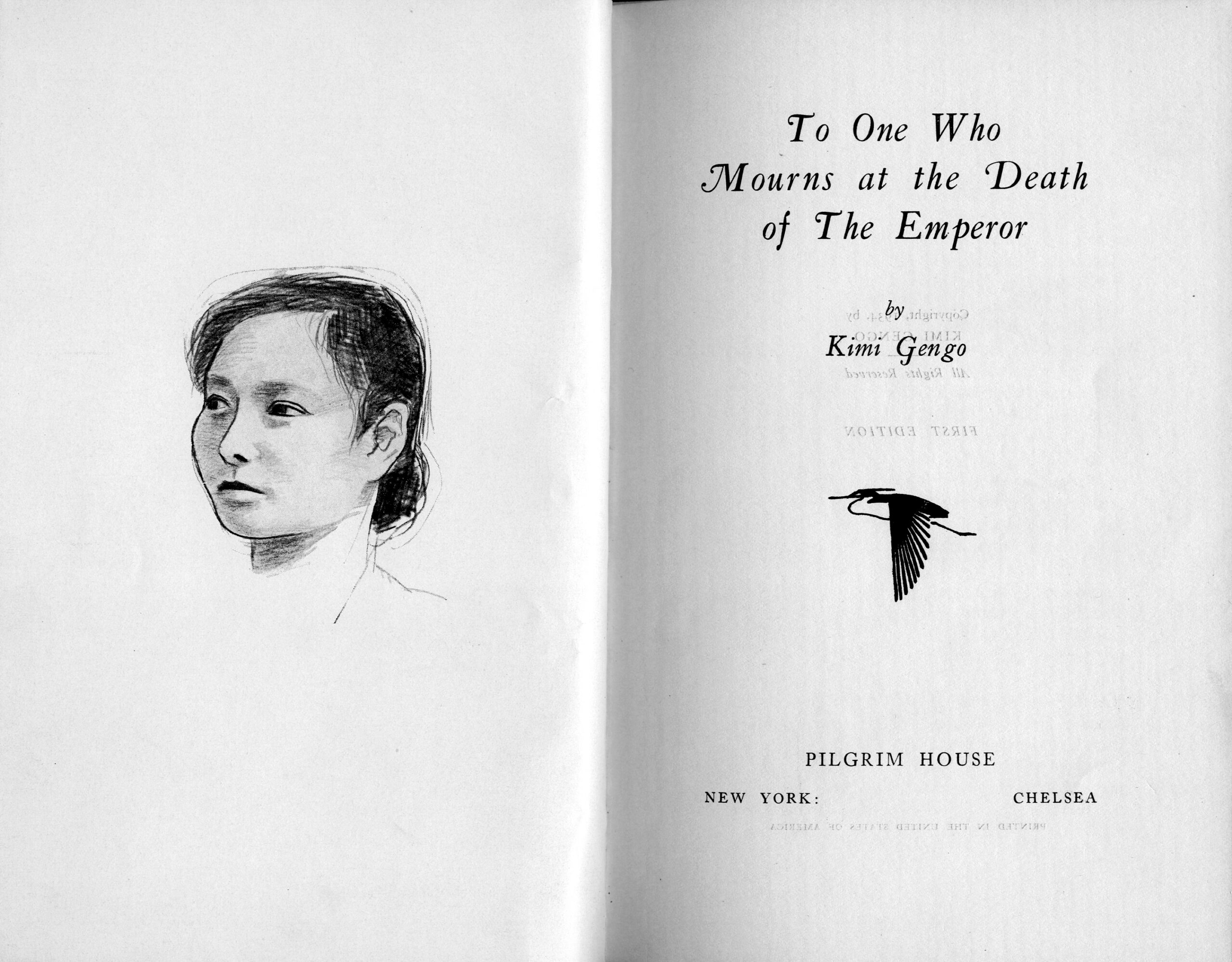
At Cornell, Kimi met Bunji Tagawa, a student from Japan who would become a painter, illustrator, and graphic artist. They married in Brooklyn in 1932 and subsequently lived on MacDougal Street in Greenwich Village. Kimi was already gaining notice for her poetry, while Bunji’s work as a visual artist developed after their move to New York. Their creative relationship is visible in Kimi’s first book: Bunji drew a pencil portrait of her for its frontispiece.
Published in 1933, To One Who Mourns at the Death of the Emperor contained Kimi’s original poetry and her English translations of Japanese verse. Some poems addressed Japanese subjects directly; others explored personal feelings in brief free verse. The translations included poems by her father, whom the book identified as “Tessu Gengo.” The collection brought several relationships onto the page: between Japanese and English, between Kimi’s writing and her father’s, and between her poems and Bunji’s portrait. It was among the earliest books published by a Nisei woman.
The Tagawas’ New York years were shaped by work as well as art. Bunji exhibited paintings and took on book illustration before building a long career in graphic design and mapmaking. Kimi worked for the Home Relief Bureau and, by 1940, was a social investigator for the New York City Department of Welfare. Her published poetry became less frequent after her first book, but she remained connected to writing and to other writers.
One of those writers was Ayako Ishigaki. Born in Japan, Ishigaki lived in New York with her husband, the artist Eitaro Ishigaki, and wrote about women’s lives and opposition to Japanese militarism. Her memoir Restless Wave appeared in 1940 under the pen name Haru Matsui. In its acknowledgments, Ishigaki thanked Kimi for assistance with the book. The available account does not say whether Kimi discussed drafts, helped with English wording, or contributed in another way. The acknowledgment nevertheless preserves a connection between two women writers whose lives intersected in New York.
Kimi and Bunji belonged to a wider Japanese American artistic world in the city. Bunji’s career moved among painting, children’s books, maps, and information graphics. Kimi’s moved among poetry, translation, social work, and writing for young readers. The connection with Ishigaki offers one documented point in this network; Bunji’s portrait for Kimi’s book offers another. Their work shows how writing and visual art could meet through shared projects and personal relationships.
The war changed the conditions of life for the Tagawa family. After Japan’s attack on Pearl Harbor, Bunji, who was a Japanese national, was subject to restrictions imposed on Japanese “enemy aliens,” including a curfew. According to family recollection, he was also placed under house arrest for a time. Kimi was a U.S.-born Nisei woman and did not face the same limits on her movement. She could run errands and carry materials for Bunji while he continued his work. Although Japanese Americans in New York were not subjected to the mass removal imposed on West Coast communities, wartime restrictions still reached into the Tagawas’ home and working lives.
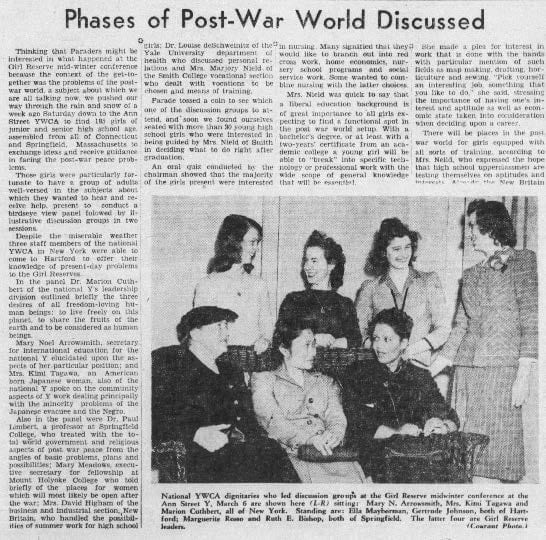
During the war, Kimi joined the staff of the national board of the Young Women’s Christian Association (YWCA). In 1943, she spoke at a YWCA conference about work concerning Japanese Americans who were resettling and African American communities. She also returned to fiction. For the YWCA magazine The Bookshelf, she wrote three stories centered on Fuji Mae, a Japanese American girl. The stories introduced readers to family relationships, food, school, and dating across Japanese and American settings. In the final installment, a Nisei boy who has recently left an incarceration camp speaks at Fuji Mae’s school.
These stories gave Kimi a way to address wartime prejudice through encounters between children. She brought a young person who had experienced incarceration into a classroom story and invited readers to consider his experience. The stories also made room for ordinary details of Japanese American family life alongside the upheaval of the war.
After the war, Kimi worked as a social worker in New York and taught at the New York School of Social Work from 1950 to 1952. She and Bunji later lived in Cobble Hill, Brooklyn, where she served as an officer of a local block association. She died in 1987.
Kimi Gengo Tagawa’s New York story encompasses poetry, translation, fiction, social work, and community activity. Her book joined her writing with Bunji’s art; Ishigaki’s acknowledgment records her place in another writer’s work; and her wartime stories carried Japanese American experiences to new readers. Together, these traces reveal a writer whose creative life extended beyond her published poetry and across decades of life in New York.
Sources: “A Union of Artists: Kimi Gengo and Bunji Tagawa,” Part 1 and Part 2; Cornell University, “Kimi Gengo: Author, Advocate, Asian American”.
No results found.
No results found.