
Jimmy Tsutomu Mirikitani (1920–2012) spent much of his life moving between places and searching for stability. Born in Sacramento, California, raised in Hiroshima, incarcerated by the United States government during World War II, and eventually settled in New York, Mirikitani transformed memories of displacement, war, and loss into art. By the end of his life, the drawings he once made and sold on the streets of Manhattan had brought his story to audiences across the country.[1]
Mirikitani was born on June 15, 1920, in Sacramento. As a child, he moved with his family to Hiroshima, where he grew up and studied art. He later described himself as “Sacramento-born, Hiroshima native.” His artistic education included training in Nihonga, or Japanese-style painting. He returned to the United States around 1940, shortly before the United States entered World War II.[2]
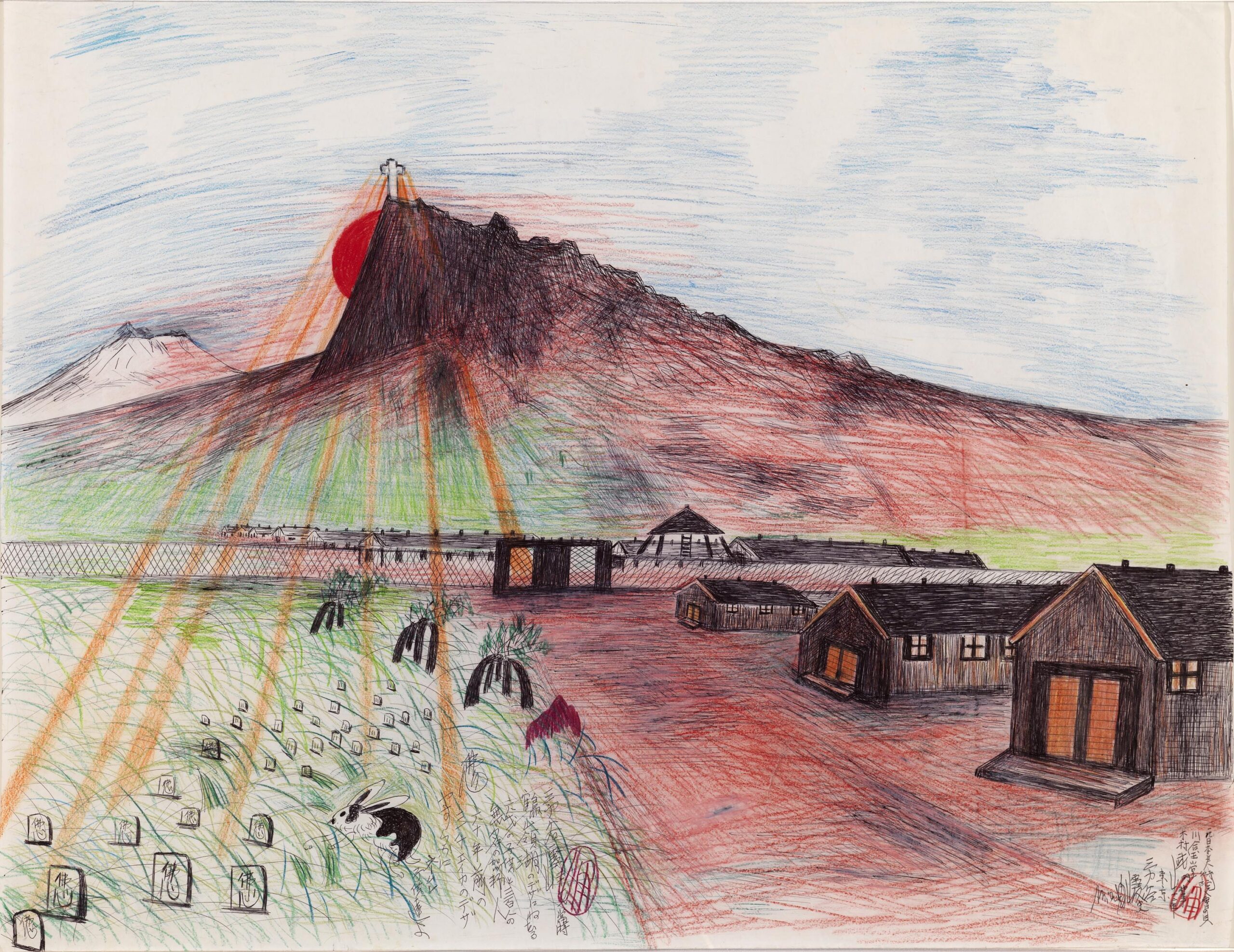
After the attack on Pearl Harbor and the forced removal of Japanese Americans from the West Coast, Mirikitani was incarcerated at Tule Lake in northern California. There, he continued to draw and paint. During the controversial wartime “loyalty” registration, Mirikitani renounced his American citizenship in protest. His incarceration did not end with the war. He was subsequently held at the Department of Justice camp in Crystal City, Texas, and in 1946 was transferred to Seabrook Farms in New Jersey, where Japanese Americans worked in the frozen-food processing industry. He was released in 1947.[3]
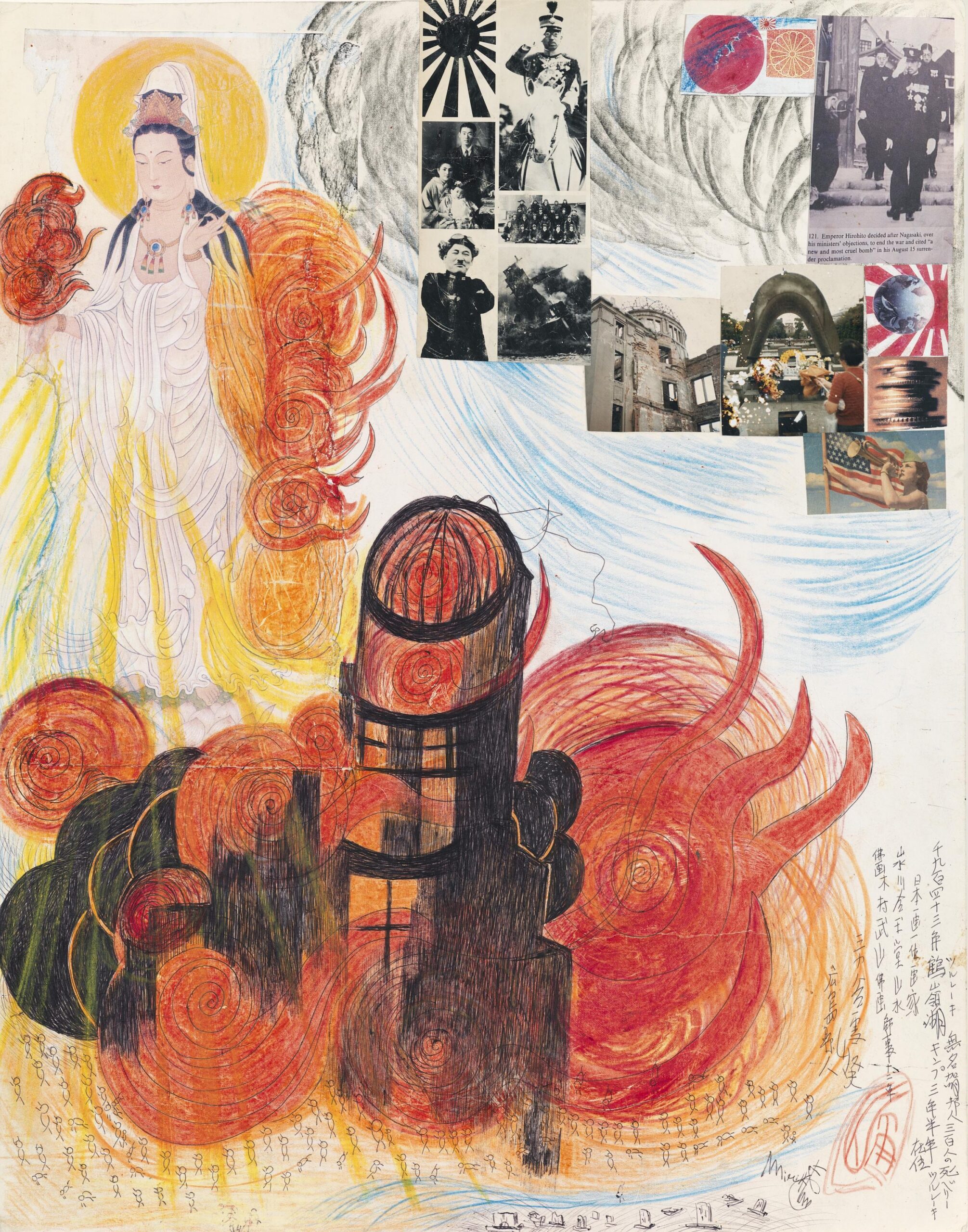
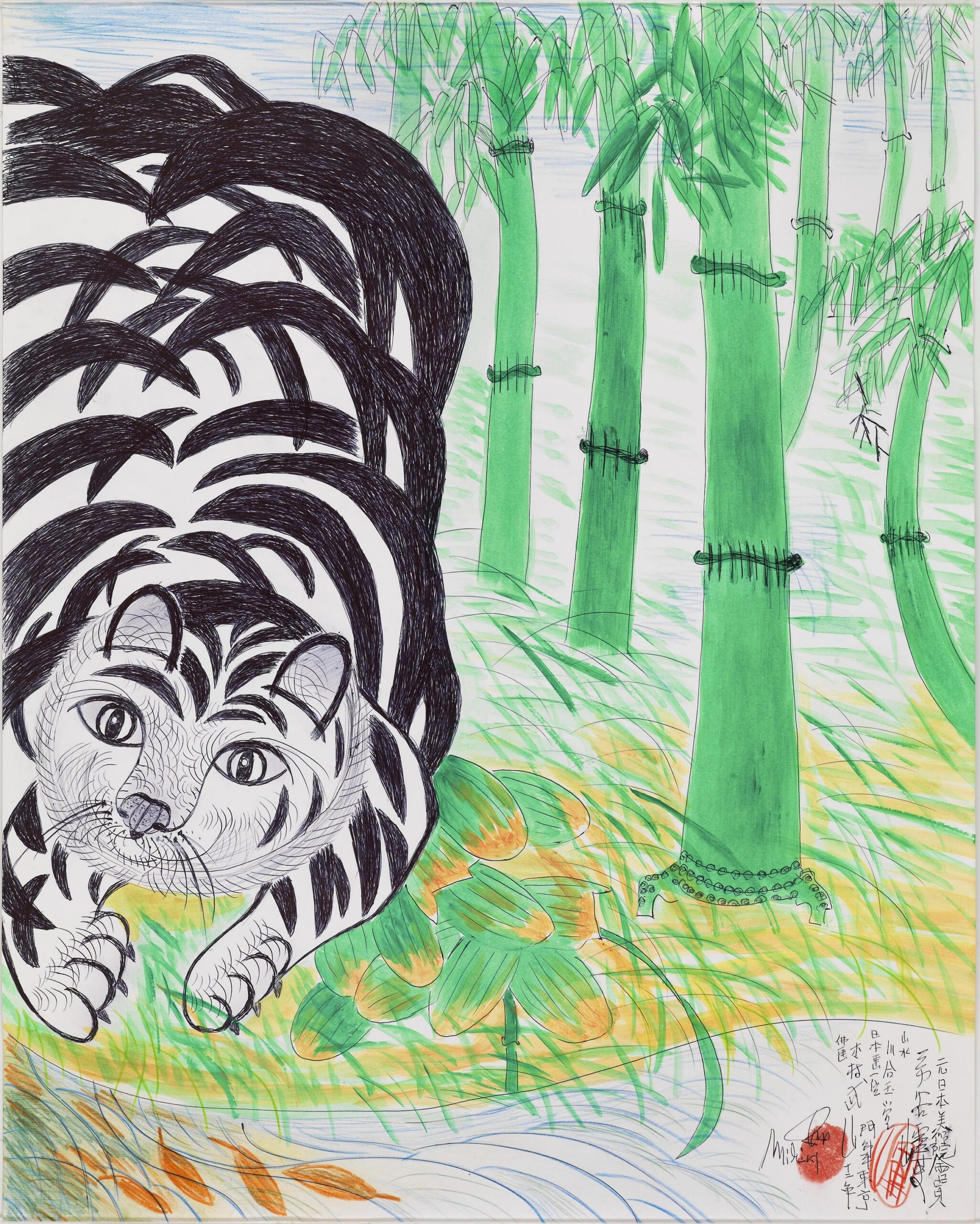
The war also brought devastating losses in Japan. Members of Mirikitani’s family and people he had known in Hiroshima were killed in the atomic bombing of the city. Memories of Hiroshima and Tule Lake remained recurring subjects in his later artwork, alongside brilliantly colored cats, flowers, fish, landscapes, and other images drawn from his life.[4]
Mirikitani came to New York City in the early 1950s hoping to rebuild his life and pursue art. According to accounts of his life, after an art professor encountered him sleeping in the Columbia University library, he was referred to the New York Buddhist Church, which provided him with assistance and helped him train as a cook. He subsequently worked at restaurants, resorts, summer camps, and country clubs along the East Coast. His U.S. citizenship was restored in 1959 through the legal efforts to assist Japanese Americans who had renounced their citizenship under the pressures of wartime incarceration, although Mirikitani apparently did not receive notice of the restoration at the time.[5]
For a period, Mirikitani worked as a live-in cook on Park Avenue. After his employer died in the 1980s, however, he again found himself without stable employment or housing. He eventually lived on the streets of Greenwich Village and Lower Manhattan, supporting himself in part by making and selling his art. Working with available materials, he created vivid drawings and collages that repeatedly returned to the experiences that had shaped him: Hiroshima, Tule Lake, and the cats that became one of his best-known subjects.[6]
In January 2001, filmmaker Linda Hattendorf encountered Mirikitani in SoHo and bought one of his drawings. She began filming him and learning the histories embedded in his work. What began as a portrait of an elderly New York street artist gradually became a record of Mirikitani’s experiences of war, incarceration, homelessness, and survival.[7]
Then came September 11, 2001.
Following the attacks on the World Trade Center, Lower Manhattan was filled with smoke and dust. Hattendorf found Mirikitani, then eighty-one years old, still living on the streets and coughing in the polluted air. She invited him into her nearby apartment. The temporary refuge marked a profound change in his life. Hattendorf subsequently helped him navigate social services and obtain benefits and housing. In 2002, Mirikitani moved into an assisted-living residence operated by Village Care of New York.[8]
The events of September 11 also gave Mirikitani’s earlier experiences an unexpected contemporary resonance. An American citizen who had been imprisoned because of his Japanese ancestry during World War II was once again living through a moment when war, fear, national security, and questions of belonging entered everyday American life. Hattendorf’s resulting documentary, The Cats of Mirikitani (2006), connected these histories while following the friendship that developed between filmmaker and artist.[9]
The film brought wider recognition to Mirikitani and his artwork. It premiered at the Tribeca Film Festival in New York in 2006 and was later broadcast nationally on PBS. His work was subsequently exhibited around the United States, including in The Art of Gaman: Arts and Crafts from the Japanese American Internment Camps, 1942–1946 at the Smithsonian American Art Museum’s Renwick Gallery.[10]
Mirikitani remained in New York until his death on October 21, 2012, at the age of ninety-two. His life connects several histories often remembered separately: Japanese immigration and transpacific identity, wartime incarceration, Hiroshima, postwar Japanese American resettlement, homelessness in New York, and September 11. Through his drawings, those histories became part of the visual record of the city in which he spent the final decades of his life.
Notes
References
Densho Encyclopedia. “Jimmy Mirikitani.” Densho.
Discover Nikkei. “‘Living Treasures’ of New York – Jimmy Mirikitani (1920–2012).” Japanese American National Museum.
Hattendorf, Linda, dir. The Cats of Mirikitani. 2006.
PBS Independent Lens. The Cats of Mirikitani. Premiered May 8, 2007.
Smithsonian American Art Museum. “Jimmy Tsutomu Mirikitani.”
Smithsonian National Museum of American History. “Drawing,” Jimmy Mirikitani, pencil sketch of Tule Lake.
Spencer Museum of Art, University of Kansas. Street Nihonga: The Art of Jimmy Tsutomu Mirikitani. 2026.
Spencer Museum of Art, University of Kansas. “Mapping the Life of Jimmy Mirikitani.” Street Nihonga virtual exhibition.
No results found.