

Ayako Ishigaki: A Writer’s Life in New York
In 1927, Ayako Ishigaki accompanied the painter Eitarō Ishigaki to Union Square, where demonstrators protested the execution of the Italian anarchists Nicola Sacco and Bartolomeo Vanzetti. She later recalled that evening as an important experience in her life. For the young woman recently arrived from Japan, New York offered encounters with people whose struggles crossed national boundaries. The city would become the center of her work as a writer, feminist, and opponent of Japanese militarism.¹
Born Ayako Tanaka in Tokyo in 1903, she came to the United States in 1926. Initially, she stayed with her sister’s family in Washington, D.C., where her brother-in-law served as a Japanese diplomat. Yet the expectations surrounding her in that diplomatic community felt little different from those she had hoped to escape in Japan. In January 1927, she left Washington for New York, seeking possibilities beyond the limited roles available to women. There she met Eitarō, a Japanese immigrant painter with socialist convictions, and began a personal and intellectual partnership with him.²
Greenwich Village placed Ayako among immigrant artists, writers, and political activists. Her relationships extended beyond New York’s relatively small Japanese community. Contacts with European and Chinese immigrants helped create a world in which arguments about women’s freedom, workers’ rights, and imperialism intersected. New York became a place from which she could examine Japan while participating in movements that connected its politics to events elsewhere. Her experiences in the city expanded both the audiences she addressed and the subjects she explored.³
Their life together also required considerable practical work. Ayako took shop and factory jobs while Eitarō painted; during summers, the couple operated concessions at Coney Island. The Depression brought severe hardship. She later remembered periods when they depended on food brought home by their friend Jack Shirai, a restaurant worker. These details place the Ishigakis within a New York sustained by precarious employment and informal networks of assistance, alongside the cultural and political activities for which they became known.⁴
Shirai’s friendship also reveals the mutual support within the city’s Japanese left. Ayako recalled intimidation by Japanese nationalist activists who opposed her political activities. Her public opposition to war made her especially visible, and she remembered Shirai and others helping protect her. New York’s Japanese community contained sharp disagreements over loyalty, nationalism, and the right to criticize Japanese policy. Living far from Japan did not remove these conflicts. For Ayako, political friendship could provide both intellectual companionship and practical protection.⁵
During the 1930s, she developed her voice through English-language publications associated with New York’s radical press, including New Masses and China Today. Her articles connected Japan’s aggression in China with conditions inside Japan, especially the exploitation of poor women. She treated women’s experiences as central to international politics. Factory labor, poverty, marriage, and reproductive freedom belonged within the same discussion as militarism and democracy. Through these publications, she brought Japanese women’s lives into debates taking place among American readers.¹
Her activism carried her beyond the city. She participated in campaigns against Japanese aggression and undertook fundraising and speaking tours with Chinese collaborators, including dancer Si-Lan Chen and writer Helena Kuo. In 1937, she briefly moved to Los Angeles, where she contributed to the Japanese-language newspaper Rafu Shimpo. She returned to New York that year, bringing experiences of West Coast immigrant life into the work that became Restless Wave.⁴
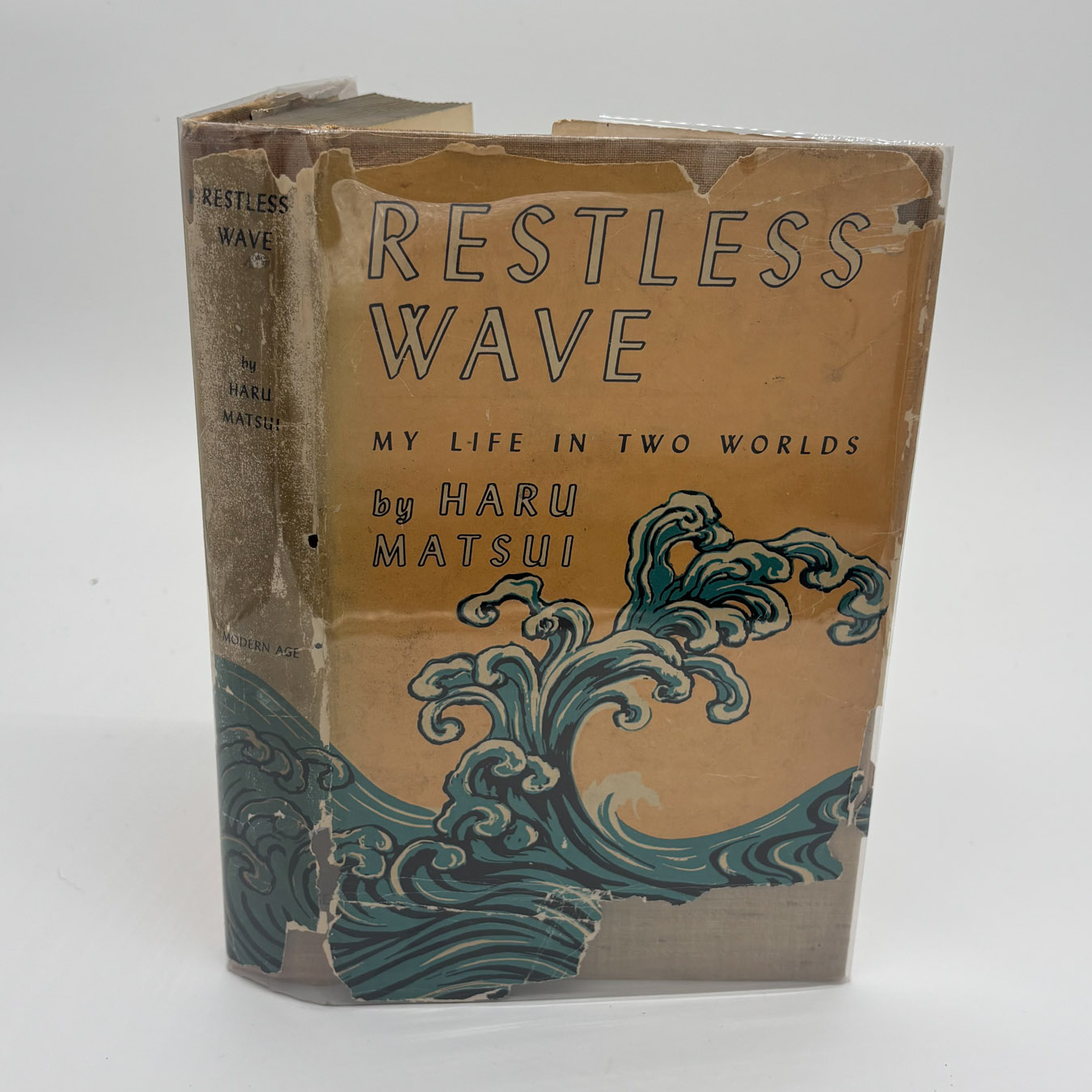
Published in 1940 under the name Haru Matsui, Restless Wave combined personal experience with fictionalized narrative. It traced a woman’s struggle against restrictive expectations in Japan and explored life in the United States. The book brought Ayako’s writing to a wider English-speaking readership. Its perspective emerged from movement between societies: she could criticize Japanese gender hierarchies while examining the racial exclusion confronting Japanese immigrants in America. Her account connected personal independence with the larger political conditions shaping women’s choices.¹
Her political thought also contained tensions. Opposition to Japanese militarism sometimes coexisted with assumptions drawn from Japanese cultural nationalism and imperial thinking. Her experience as a Japanese woman abroad involved changing positions: she belonged to a racial minority in the United States but came from the dominant national population of an empire. Her writing reflected these overlapping circumstances. Read together, her Japanese and English texts reveal how migration, political relationships, and changing audiences shaped her understanding of gender, solidarity, and national identity.³
World War II changed the circumstances of her work. In 1942, Yasuo Kuniyoshi recruited her to participate in anti-Axis broadcasts. She subsequently worked as a translator and writer for the Office of War Information. After the war, she resumed newspaper writing for New York’s Hokubei Shimpo. Increasing government pressure during the early Cold War eventually disrupted the Ishigakis’ American lives. When Eitarō was expelled from the United States in 1951, Ayako returned to Japan with him.⁴
Ayako’s New York story connects women’s everyday experiences to international political questions. Her life reveals the contributions of a Japanese immigrant woman to the city’s literary and activist communities, while preserving the complexities of the world in which she worked.
Footnotes
No results found.