Henry Yuzuru Sugimoto (1900–1990) was a Japanese American painter whose career spanned more than six decades and whose work documented immigration, racial discrimination, wartime incarceration, and life in the United States. Born in Wakayama, Japan, Sugimoto joined his parents in California in 1919. He studied painting at the California School of Arts and Crafts and later traveled to France, where he became associated with Japanese artists in Paris. After one of his landscapes was accepted by the Salon d’Automne in 1931, he returned to California and received significant attention for a solo exhibition at San Francisco’s Legion of Honor Museum in 1933.
During World War II, Sugimoto, his wife Susie, and their daughter Madeleine were forcibly removed from their home and incarcerated at the Jerome and Rohwer camps in Arkansas. There, he created approximately one hundred paintings, watercolors, and drawings recording daily life behind barbed wire. Working at times on sheets, pillowcases, and mattress covers when conventional art materials were unavailable, Sugimoto used painting both to document the community around him and to protest the injustice of the government’s actions.
After leaving Rohwer in 1945, Sugimoto discovered that the paintings he had stored in San Francisco before the war had been sold at auction. Unable to recover either the works or their proceeds, he relocated with his family to New York City. New York became his home for the rest of his life and the setting for the final four decades of his career. He continued to paint while supporting his family through work as a textile designer and book illustrator. His published work included illustrations for Toyohiko Kagawa’s Songs from the Land of Dawn in 1949 and Yoshiko Uchida’s children’s book New Friends for Susan in 1951.
Sugimoto also remained active as an exhibiting artist in New York. His work was presented in solo exhibitions at Galerie Internationale in 1962 and 1965 and at the Wiener Gallery in 1974. Although these exhibitions received limited public attention at the time, his incarceration paintings gradually became recognized as important works of Japanese American history. The Japanese American National Museum now holds the largest collection of his art, encompassing his landscapes, New York scenes, prints, illustrations, and paintings documenting wartime incarceration.
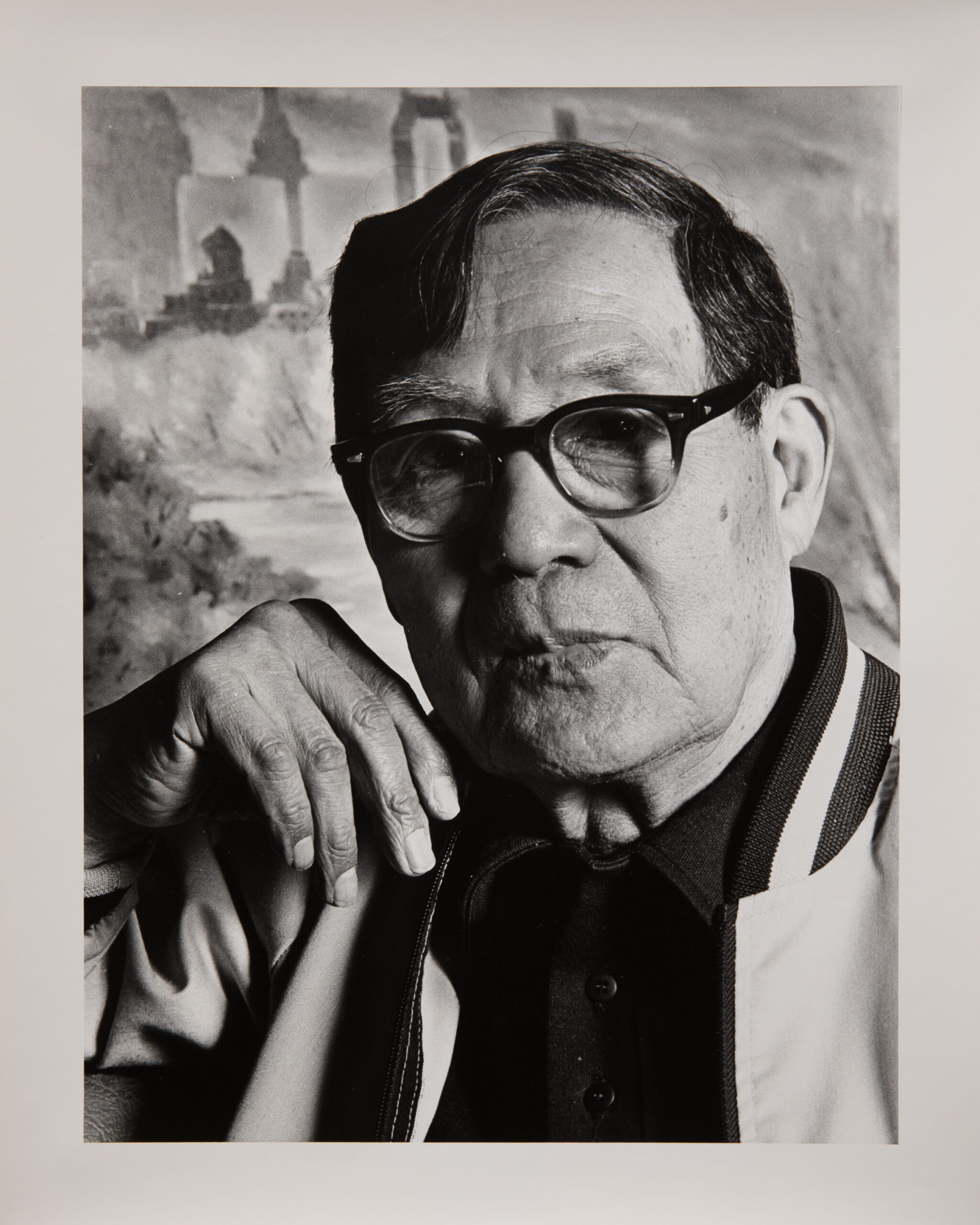
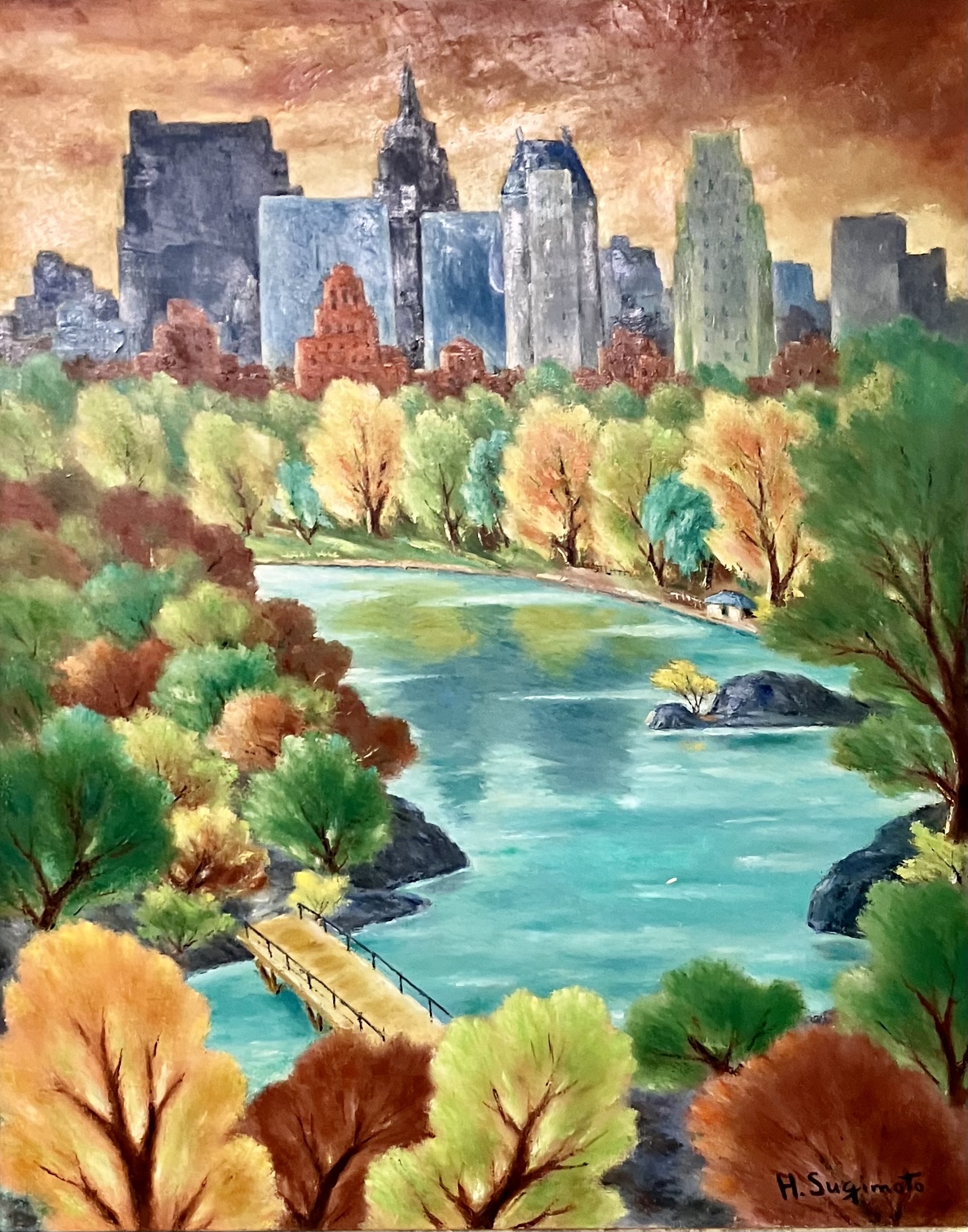
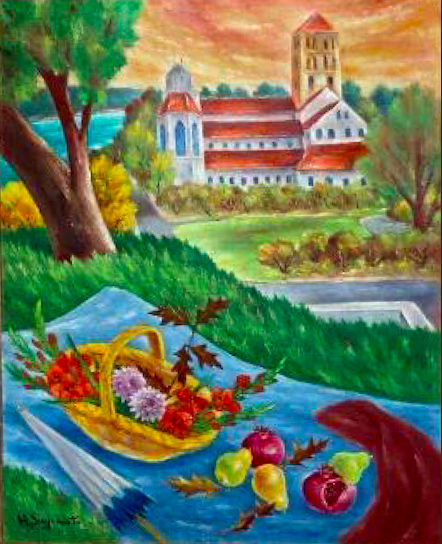
The archival materials presented here illuminate Sugimoto’s life and work during his New York years. Hiroyuki “Tora” Inoue’s photographic portrait shows the artist seated before one of his own paintings. The partially visible canvas can be identified through the accompanying color photograph as a view across Central Park toward the Manhattan skyline. Its vivid autumn foliage, lake, and rising buildings place Sugimoto within the city that became his postwar home. A second painting, depicting a picnic arranged in a park landscape overlooking the Cloisters in Fort Tryon Park, further reflects his interest in New York’s architecture, parks, and changing seasons. Both paintings are held by the Consulate General of Japan in New York.
Sugimoto’s New York landscapes differ in subject from his best-known incarceration paintings, but they belong to the same long artistic journey. The Central Park painting behind him in Inoue’s portrait is not simply a decorative background. It connects the aging artist to the city where he rebuilt his life after incarceration, raised his family, continued painting, and became involved in the movement to preserve the history of Japanese Americans.
The additional documents reveal how Sugimoto’s art entered the public discussion of wartime incarceration. A September 1978 issue of The New York Nichibei reported that one of his paintings of camp life in Arkansas had appeared in color on the cover of Response, a publication of United Methodist Women. The article also noted that a group of his incarceration paintings had recently been exhibited at the Interchurch Center in New York.
On November 23, 1981, Sugimoto appeared at the New York public hearing of the federal Commission on Wartime Relocation and Internment of Civilians. Listed on the program alongside artist Mine Okubo and other former incarcerees and community figures, he presented his experiences as part of the national investigation that ultimately contributed to the movement for redress and reparations.