Leo Amino (1911-1989) was one of the artists featured in the 1939 New York World’s Fair, along with Isamu Noguchi. Following Pearl Harbor, Amino’s New York home was searched, and he was interrogated by the Secret Service. For the duration of the war, he translated legal documents of the Japanese government. Amino was also on the executive committee of the JACD Arts Council which Noguchi and Kuniyoshi chaired.
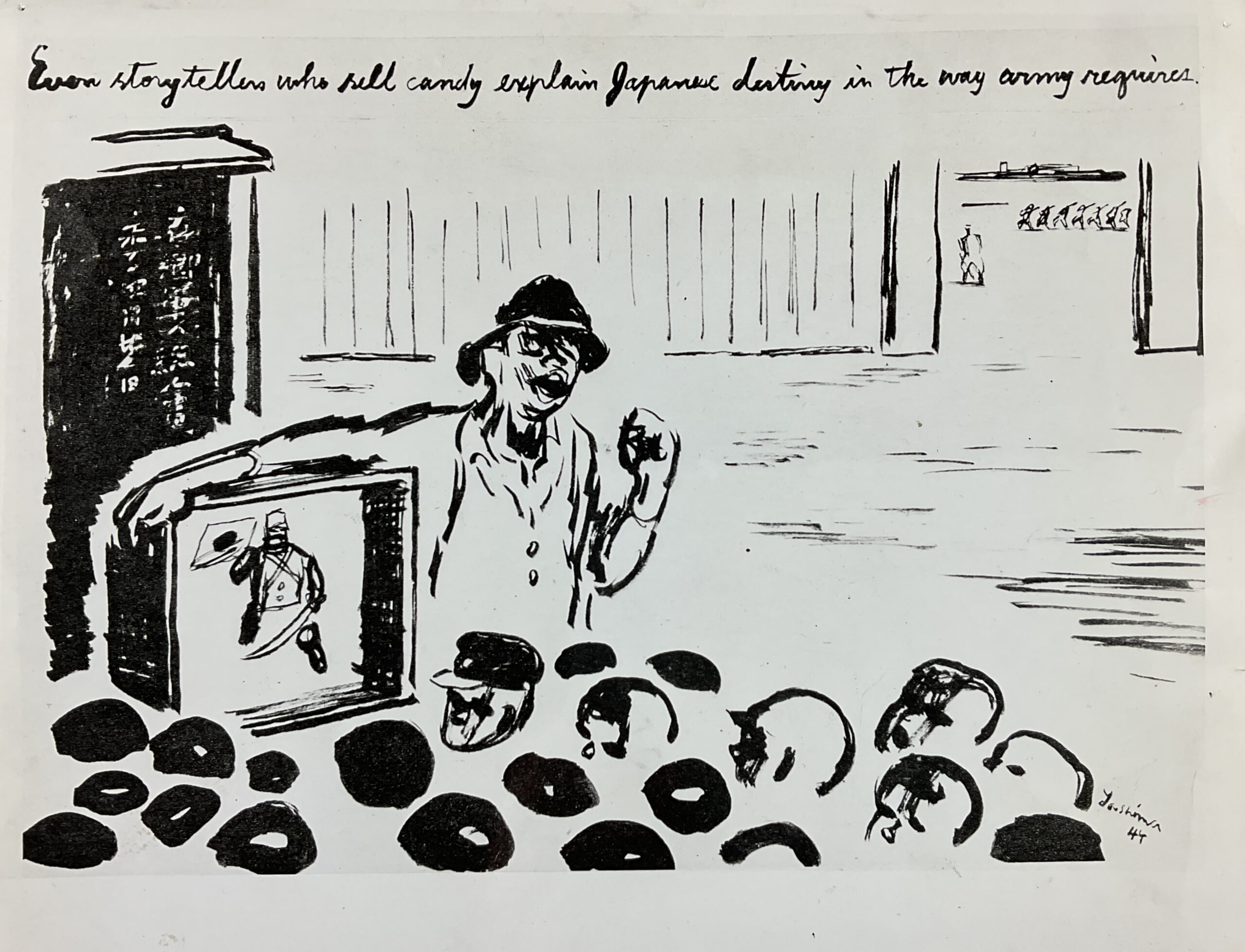
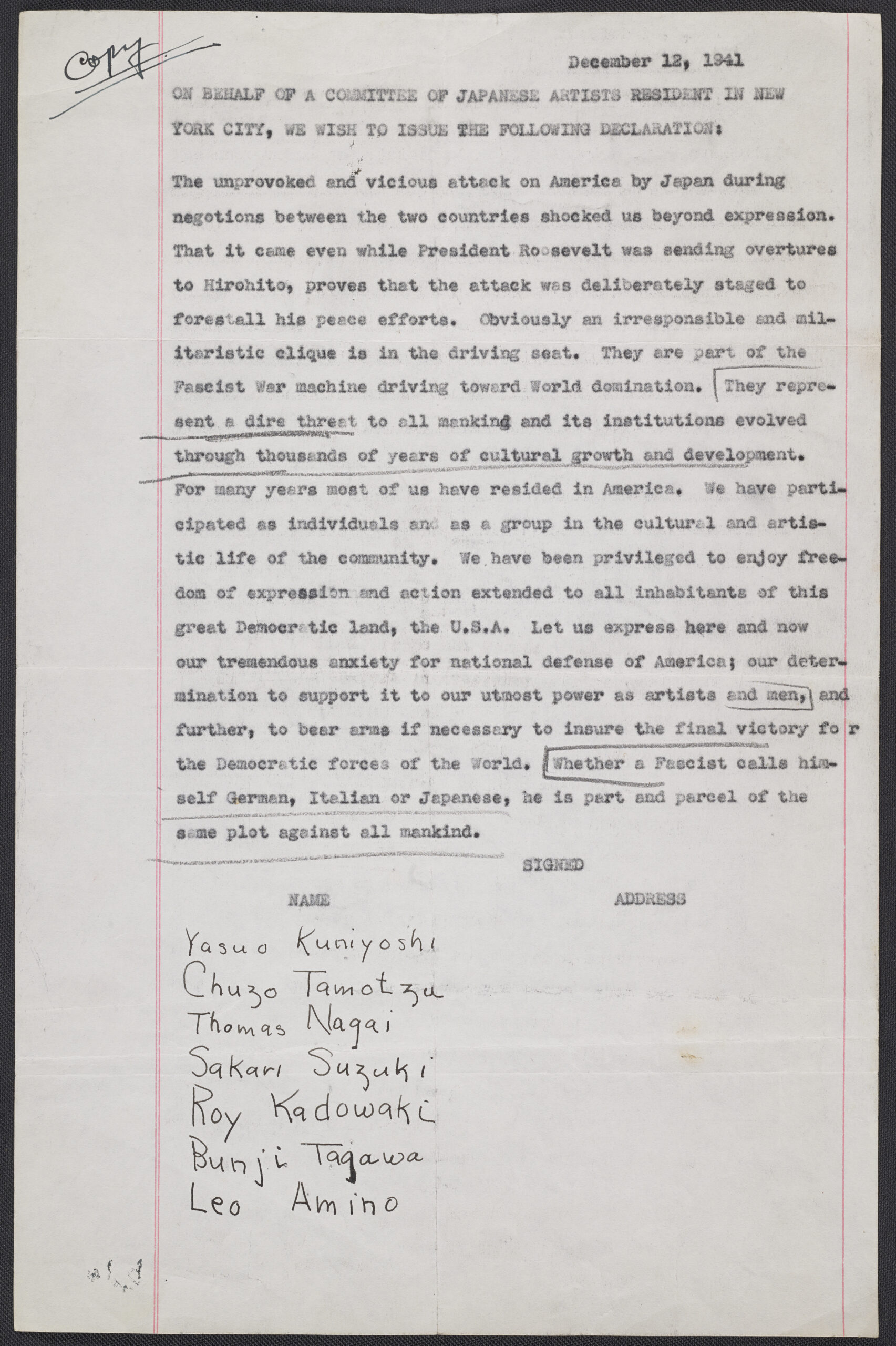
In December 1941, Amino, Kuniyoshi, Tamotsu, Noguchi,Thomas Nagai, Roy Kadowaki, Sakari Suzuki (1899-1995), and Bunji Tagawa signed a document denouncing Japanese fascism. Taro Yashima (1908-1994)departed Japan in 1939, enlisted in the U.S. Army, and served as an artist for the U.S. Office of War Information (OWI) and the Office of Strategic Services (OSS). Yashima published a 310-page autobiographical picture book, The New Sun, for adults about prewar Japan in 1943.
Minoru Yamasaki (1912-1986), a Nisei architect, became a representative of the Japanese Americans for Democracy Art Council and chairman of the organization coordinating the resettlement of Japanese Americans in New York City. Yasuo Kuniyoshi (1889-1953), a prominent artist, created a series of anti-war posters commissioned by the Office of War Information (OWI). In addition, he delivered a radio address to Japan that emphasized the importance of democracy. Chuzo Tamotzu (1888-1975) was assigned to the Office of Strategic Services (OSS) and deployed to Southeast Asia. Isamu Noguchi (1904-1988), a resident of New York, was not subject to government evacuation orders. However, he voluntarily reported to the Poston War Relocation Center in Arizona.
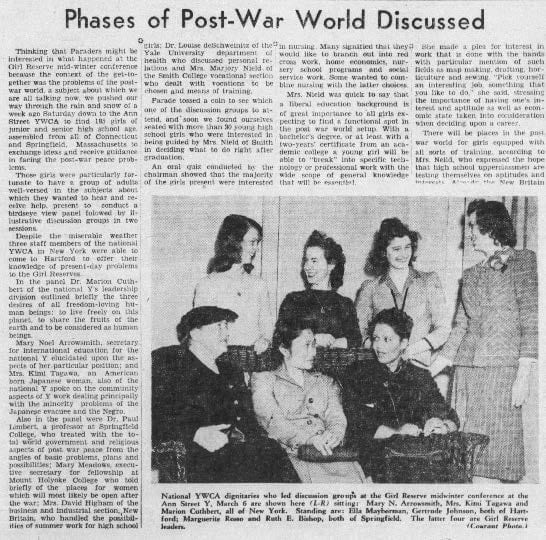
"Phases of Post-War World Discussed." Photo of National YWCA dignitaries at the Girl Reserve midwinter conference in 1943, including Kimi Gengo Tagawa (front row, center). Mrs. Kimi Tagawa, an American born Japanese woman, also of the national spoke on the community aspects of work dealing principally with the minority problems of the Japanese evacuee and the Negro. Courtesy of Hartford Courant/TCA, March 14, 1943
Ayako Ishigaki was an Issei journalist, activist, and feminist who published a memoir, Restless Wave, in 1940, with the help of Kimi Gengo Tagawa. It was acclaimed in the U.S., though its strong criticism of wartime Japanese society and militarism also led to negative attention from the Japanese government. Ayako and her spouse, the artist Eitaro Ishigaki (1893-1958), had to register as enemy aliens but didn’t face imprisonment because of their pro-democracy sentiments. Nonetheless, they were subject to curfews, random searches, and job loss. In 1942, Ayako began working for the OWI.
1943年から1944年にかけて、田川(源五)君は、ガール・リザーブズ(1918年に始まったYWCA(Young Women's Christian Association)のプログラム)のための雑誌『本棚』に、一連の物語を掲載した。この物語集で、君は架空の会話を交えながら、アメリカと日本の文化、移民、社会への融合について読者に説いた。君の配偶者である田川文治もJACDで活躍し、君の著書『天皇の死を悼む人へ』に挿絵を寄せた。
Frank Masao Okamura was born in Hiroshima on May 5, 1911, and moved to California at the age of 13 to join his father, who had gone there in search of work. He lived with a British family while attending high school and returned to Japan briefly to marry. He and his wife, Toshimi Nishikubo, then returned to America to start a small gardening business in the Los Angeles area. Okamura lost his business in 1942 when he, his wife, and their two young daughters were sent to the Manzanar Relocation Camp in the California desert. The family lived there for three years and eight months until the end of the war.
Okamura was on the staff of the Brooklyn Botanic Garden from 1947 to 1981, first as a gardener in charge of the Hill and Pond Japanese Garden, then as a bonsai specialist responsible for caring for the Garden’s large and important collection of bonsai, the miniature, potted trees grown using techniques developed in Japan. Okamura also taught the Botanical Garden’s bonsai classes and lectured nationwide, instructing thousands of students in the art of bonsai. He has written articles on the subject for the World Book Encyclopedia and the Encyclopedia of Japan, an English-language work published by the Japanese company Kodansha.
The Okamuras, who lived in a brownstone they owned on the Upper West Side, rented rooms to visitors from Japan. One of their tenants was Dr. Daisetz T. Suzuki, the scholar and writer who brought Zen Buddhism to the West. He lived there for four years, beginning in 1958, while he gave his famous lectures at Columbia University.