
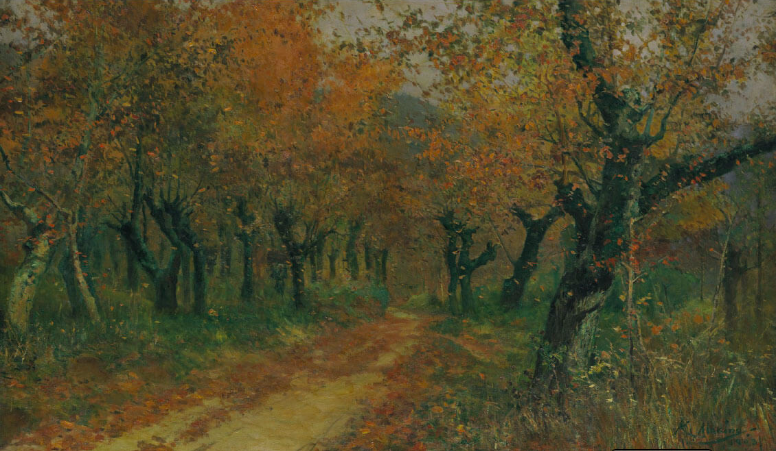
Makino Katsuji was a Western-style painter, educator, and designer born in present-day Fujiidera, Osaka Prefecture. He studied Western painting under Morizumi Isana and Japanese-style painting under Morizumi Tsurana. After moving to Tokyo, he continued his training at Fudosha, the private painting school led by Koyama Shotaro.
Makino was a founding member and central figure of the Kansai Art Society. In 1902, he became an associate professor in the Department of Design at the newly established Kyoto Higher School of Arts and Crafts, a predecessor of Kyoto Institute of Technology. There, he taught painting and design alongside Asai Chu and other artists.
Teaching at the New York School of Art
In 1906, Makino traveled to the United States with Shimotori Yukihiko. He was active in New York between 1906 and 1913, with a temporary return to Japan while arranging materials and collaborators for the Jokichi Takamine residence project.
During this period, Makino taught watercolor painting at the New York School of Art while continuing his study of Western painting and introducing Japanese artistic traditions.
Makino worked not only as a painter and educator but also as a designer of architectural interiors, furniture, decorative objects, and commemorative items. His activities formed part of the broader exchange of art, architecture, and design between Japan and the United States during the early twentieth century.
Interior Design of Shōfūden
Shōfūden was a Japanese pavilion constructed for the 1904 Louisiana Purchase Exposition in St. Louis. After the exposition, Jokichi Takamine had the building relocated to his summer estate in Forestburgh, New York.
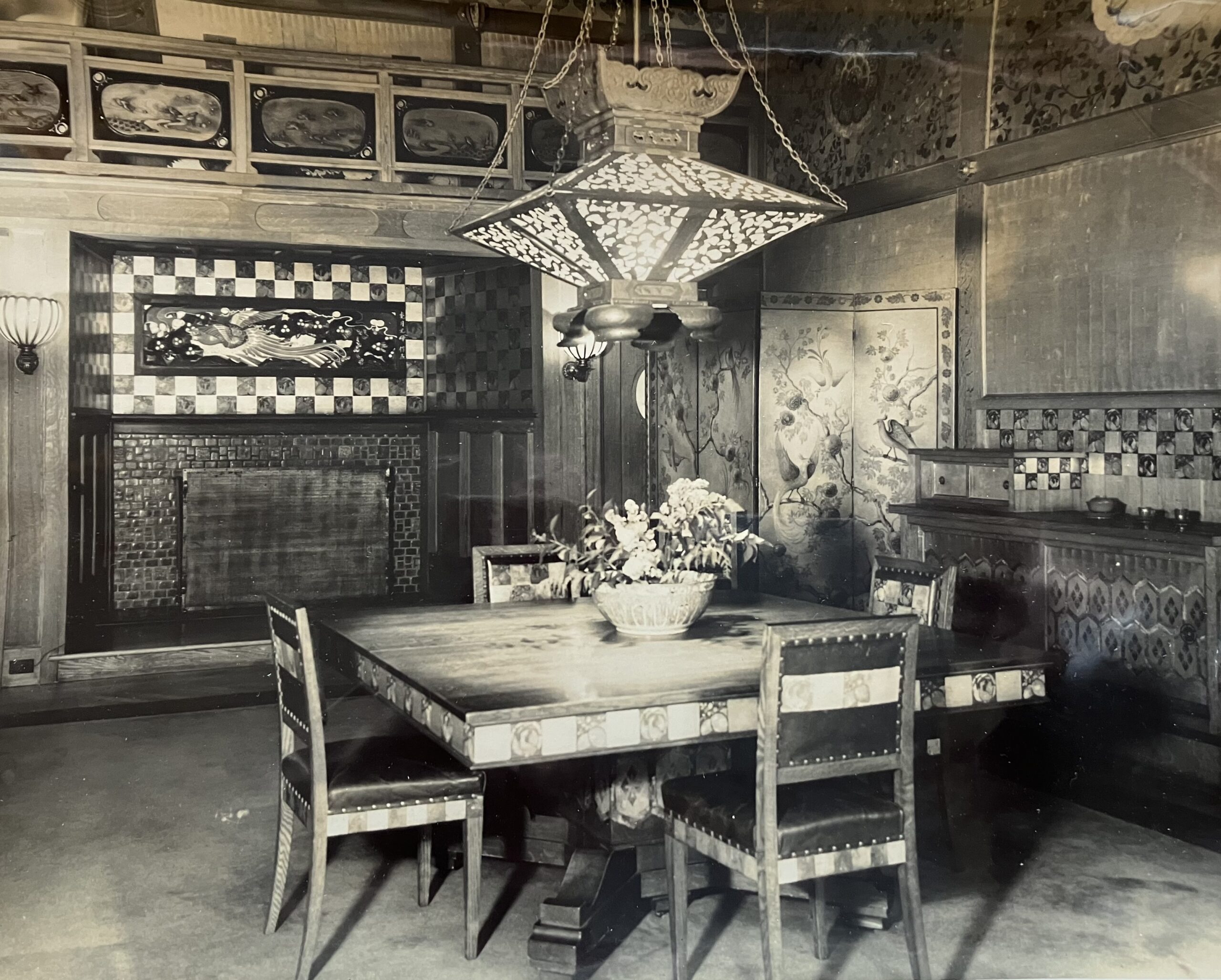
Around 1908, Makino undertook the interior decoration of Shōfūden. His work incorporated traditional Japanese motifs while adapting materials and techniques to the building’s American environment. Because paper and silk were vulnerable to New York’s dry, heated interiors, Makino used oil paint on canvas, sometimes applied over gold leaf, to create Japanese-style decoration suited to local conditions.
Shōfūden should not be confused with Hōōden, the Japanese pavilion constructed for the 1893 World’s Columbian Exposition in Chicago. Hōōden was modeled on the Phoenix Hall of Byōdō-in Temple. It remained in Chicago after the exposition and was later destroyed by fire. Shōfūden and Hōōden were constructed for different expositions, in different years and locations, and were separate buildings.
Jokichi Takamine’s New York Residence
In 1908, Makino was commissioned to design the interiors of Jokichi Takamine’s New York residence. Located at 334 Riverside Drive, the residence was completed in 1912.
Makino based the interiors primarily on the aesthetics of the Fujiwara period while also incorporating elements associated with the Muromachi and Edo periods. Rather than reproducing a traditional Japanese interior without alteration, he adapted materials and construction methods to New York’s climate and architectural conditions.
The broader project involved architect Takeda Goichi, the Kyoto Higher School of Arts and Crafts, Yamanaka & Company, the Nomura family of Kyoto, and the Kawashima textile company, among other Japanese architects, craftspeople, institutions, and businesses. Makino helped coordinate the designs, materials, furnishings, and decorative objects produced in Japan and installed in New York.
The Nippon Club of New York
Makino was also involved in the building and interior design of the Nippon Club of New York. The Museum and Archives of Kyoto Institute of Technology preserves architectural drawings, interior photographs, contracts, furniture and decorative designs, tableware, insignia, and other materials connected with the project.
These records demonstrate that Makino’s work extended beyond painting to encompass architecture, furniture, decorative arts, and graphic design.
Makino also created designs for a commemorative cup and silver medal associated with the 1912 presentation of cherry trees to New York City and the commemoration of Sakura Park.
Correspondence with Charles Lang Freer
The Charles Lang Freer Papers contain correspondence from 1912 and 1913 concerning Makino’s preliminary designs for a proposed Japanese gallery in Freer’s planned museum in Washington, D.C.
Makino proposed a central hall in the Fujiwara style, accompanied by smaller rooms based on the artistic traditions of the Kamakura, Higashiyama, Momoyama, and Ashikaga periods. He also proposed designing benches, display cases, and other furnishings to harmonize with the objects exhibited in each room.
The project was suspended after changes to the proposed museum site required an entirely new building plan. The correspondence nevertheless documents Makino’s participation in an early plan for the museum that would later become the Freer Gallery of Art.
Return to Japan and Preservation of His Archives
Makino returned to Japan in 1913. After a period in Taiwan, he entered the service of the Kuni branch of the Imperial Family in 1915 and moved to Tokyo in 1918. He died in 1942.
A substantial group of works, photographs, correspondence, architectural drawings, contracts, and designs formerly preserved by the Makino family is now held by the Museum and Archives of Kyoto Institute of Technology.
In 2022, the museum presented the exhibition Makino Katsuji and Shimotori Yukihiko: The Various Faces of the Western Painting Artists. The exhibition examined their work in the United States, their varied artistic activities, and their relationship with the university.
These materials document Makino’s work as a painter, educator, and designer and demonstrate his role in the exchange of art, architecture, and decorative design between Japan and the United States during the early twentieth century.
References and Related Resources
No results found.
No results found.