Kōsaku Yamada, approximately 1915–1920. Photograph published by the Bain News Service. George Grantham Bain Collection, Prints and Photographs Division, Library of Congress, LC-DIG-ggbain-27699.
In 1918 and 1919, Kōsaku Yamada (Yamada Kōsaku; 1886–1965) conducted two programs of his compositions at Carnegie Hall. Carnegie Hall identifies him as the first Japanese conductor to appear there.
The concerts introduced U.S. audiences to a Japanese composer working within European-derived orchestral traditions. They were also shaped by wartime diplomacy and by expectations that Japanese artists should represent an identifiable and culturally distinct “Japan.”
Yamada’s reception in New York reveals both the possibilities and the limitations of cultural exchange in the early twentieth century.
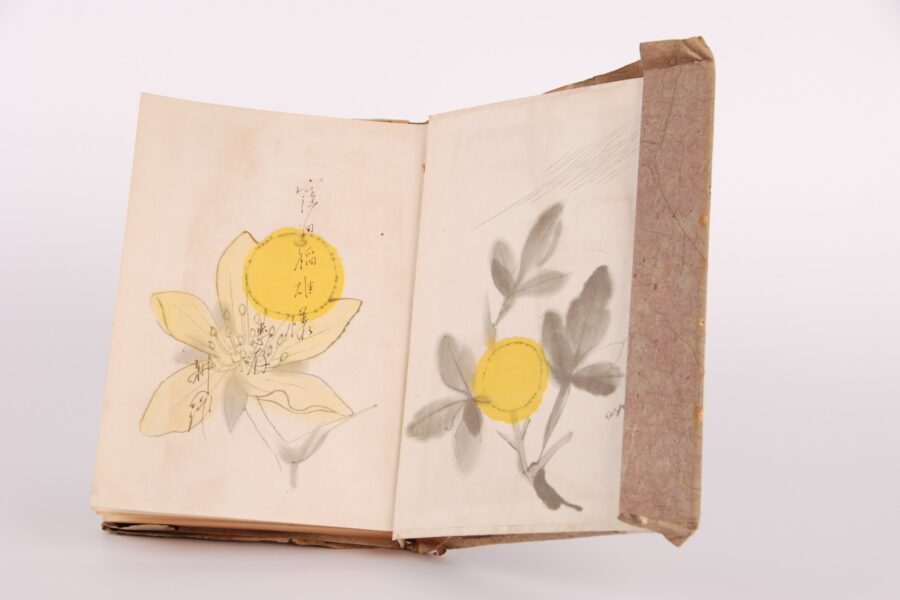
Manuscript of Yamada Kōsaku’s autobiography, Rhapsody of Youth. The manuscript recounts his life through his return from Germany and includes Yamada’s handwritten revisions. Tokyo University of the Arts Archive Center. (View the manuscript and complete digital collection: https://archive.geidai.ac.jp/en/8157/)
Yamada studied voice, cello, and composition at the Tokyo Music School. From 1910 to 1913, he continued his musical education in Berlin, where he studied composition and encountered the work of Richard Strauss, Alexander Scriabin, Arnold Schoenberg, and other contemporary European composers.
In Berlin, Yamada completed his Symphony in F major, later titled Triumph and Peace. Widely recognized as the first symphony composed by a Japanese musician, the work reflected his training within European orchestral traditions.
After returning to Japan, Yamada sought to establish professional orchestras, expand opportunities for Japanese musicians, and create a place for Japanese composers within an increasingly transnational concert culture.
Carnegie Hall, October 16, 1918
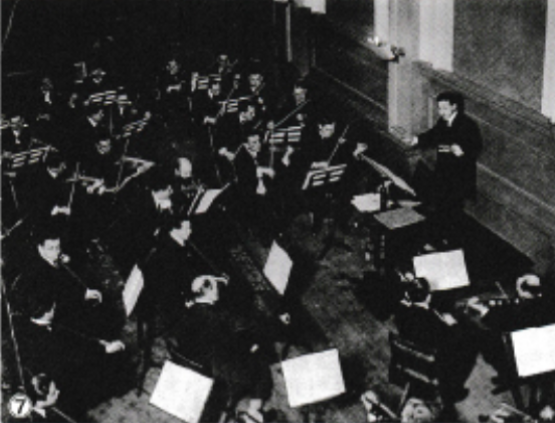
Yamada arrived in the United States in January 1918. On October 16, he conducted a Carnegie Hall concert devoted to his compositions. The performers included musicians associated with leading New York orchestras, members of the New Choral Society, and baritone Clarence Whitehill.
Kōsaku Yamada conducting an orchestral rehearsal in New York, 1918. The source identifies the photograph as a rehearsal for his first Carnegie Hall concert, held on October 16, 1918. Image source: Yamada Kōsaku and Akatombo Lovers Association (https://yamadakosaku.jp)
The program included orchestral and vocal works such as The Dark Gate, The Flower of Mandara, Maria Magdalena, Two Legends of Old Japan, and Coronation Prelude.
Yamada did not present traditional Japanese music. He appeared as the composer and conductor of contemporary orchestral works shaped by his experiences in Japan and Europe. His presence challenged assumptions about who could claim authority within the concert hall.
Music and Wartime Diplomacy
Yamada’s first concert took place during the final weeks of World War I, when Japan and the United States were allied powers. Japanese ambassador Ishii Kikujirō and prominent members of New York’s Japanese and U.S. communities attended.
During the intermission, Kasai Jiuji placed Yamada’s music within this diplomatic context:
“Japan speaks to you through Mr. Yamada in a language universal to your hearts.”
The concert was not an official Japanese government presentation. Nevertheless, its speakers and supporters framed it as an expression of friendship between Japan and the United States.
Music became a vehicle through which Japan could be represented to a U.S. audience. Yamada’s compositions, however, did not always conform to the cultural image that audience expected.
Hearing Japan in New York
New York critics recognized Yamada’s authority as a conductor and his command of orchestral color. Their reviews also reveal the racialized and exoticizing expectations placed upon a Japanese composer.
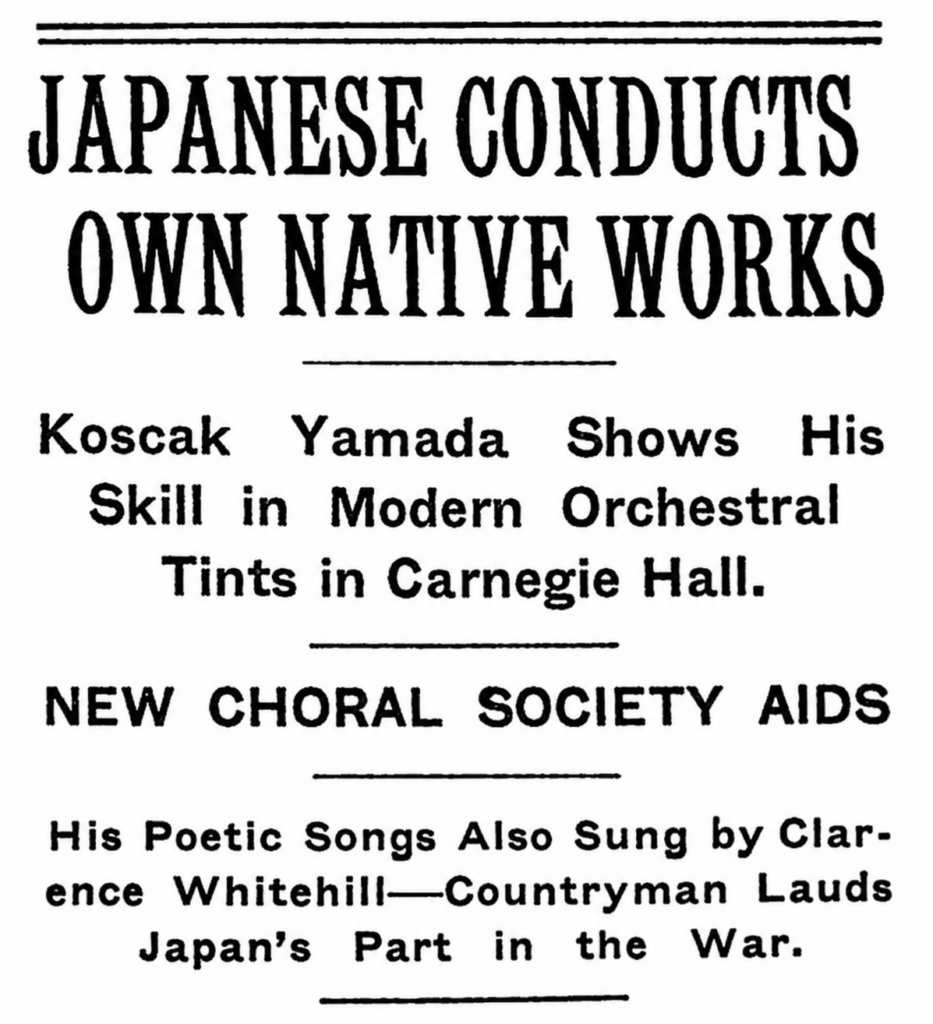
“Japanese Conducts Own Native Works,” The New York Times, October 17, 1918. The review praised Yamada’s conducting and orchestral technique while interpreting his compositions through contemporary U.S. ideas about Japanese art.
The New York Times praised Yamada’s musical restraint by comparing it to the work of the Japanese artist Hokusai. A reviewer for the Evening Post, by contrast, expressed disappointment that the compositions sounded too European and did not provide a sufficiently unfamiliar or picturesque image of Japan.
These responses placed Yamada in a double bind. Critics expected his music to be internationally legible while also demanding audible evidence of cultural difference.
Rather than treating either “Japanese” or “European” music as a fixed category, Yamada’s work demonstrates how modern composition developed through movement, study, adaptation, and exchange across national borders.
A Second Carnegie Hall Concert
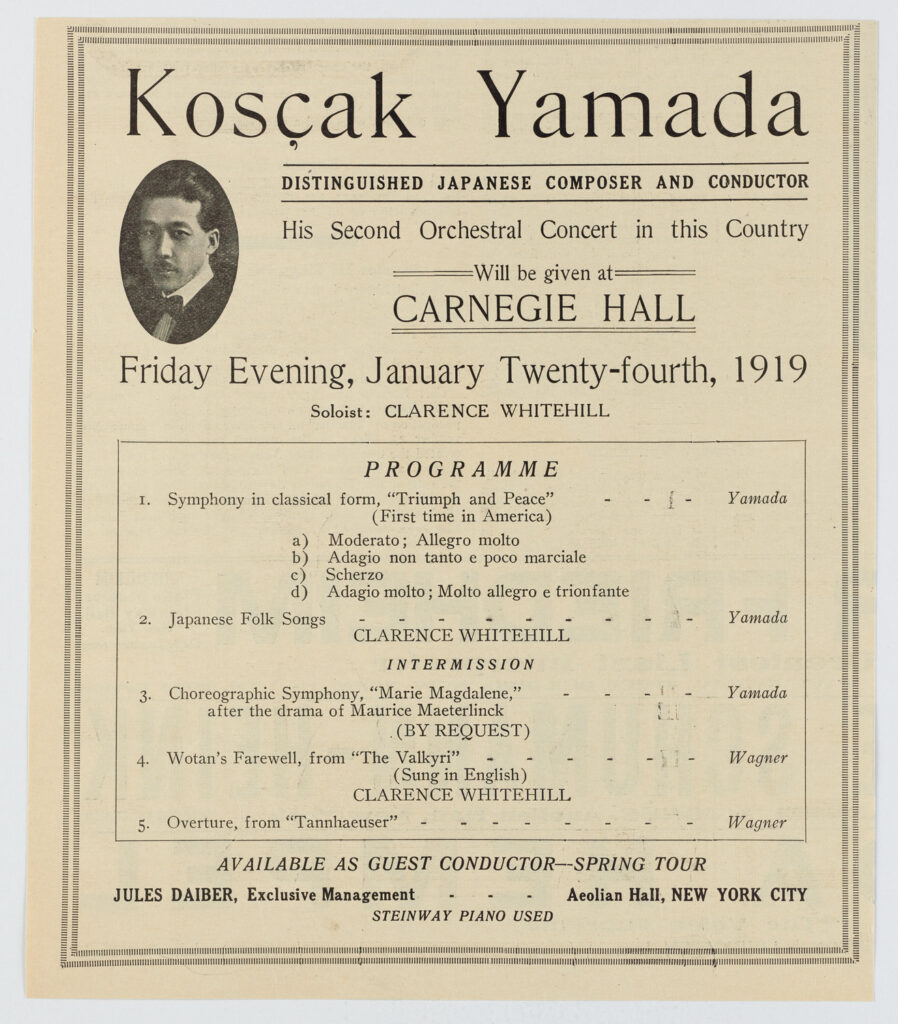
Flyer for the Koscak Yamada Orchestral Concert, January 24, 1919. Presented by the Japan Society, the concert included the U.S. premiere of Yamada’s Symphony in F major, Triumph and Peace. Carnegie Hall Rose Archives.
The armistice of November 11, 1918, ended the fighting in Europe between Yamada’s two appearances.
On January 24, 1919, the Japan Society presented Yamada’s second Carnegie Hall concert. The program included the U.S. premiere of his Symphony in F major, Triumph and Peace.
The second concert was not simply a repetition of his debut. It gave Yamada an opportunity to present his most ambitious early symphonic composition and strengthened his public identity as both a composer and conductor.
Symphony in F, “Triumph and Peace” (1912). Yamada composed this work in Berlin as part of his advanced musical studies. Widely recognized as the first symphony composed by a Japanese musician, it reflects his training in the late-Romantic European orchestral tradition. Yamada conducted its U.S. premiere at Carnegie Hall on January 24, 1919.
Yamada returned to Japan in May 1919. His Carnegie Hall concerts did not immediately secure a permanent international conducting career. They nevertheless established an important precedent: a Japanese composer appearing before a U.S. audience as the author and conductor of contemporary orchestral music.
The concerts also raised a question that followed Yamada throughout his career: how could a Japanese composer participate in an international musical culture without being confined by other people’s expectations of what Japanese music should sound like?
Music and Visual Culture
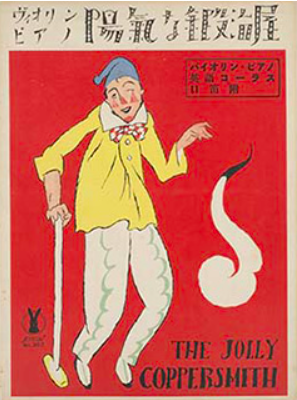
Yumeji Takehisa [cover design], The Merry Blacksmith: Senoo Music Series No. 357 (1924). Collection of the Chiyoda City Board of Education.
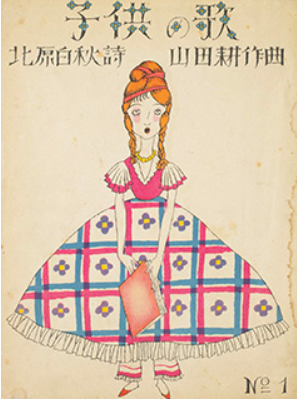
Yumeji Takehisa [cover design], Children’s Songs: Senoo–Yamada Music Series No. 1 (1926). Collection of the Chiyoda City Board of Education.
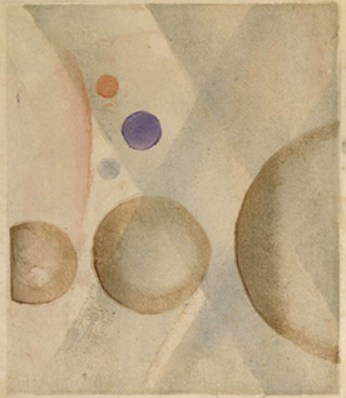
Kōshirō Onchi, Lyricism through Musical Works No. 4: “Oyasumi (Good Night)” from Kōsaku Yamada’s “Japanese Shadow Play”, 1934. Collection of the Aichi Prefectural Museum of Art.
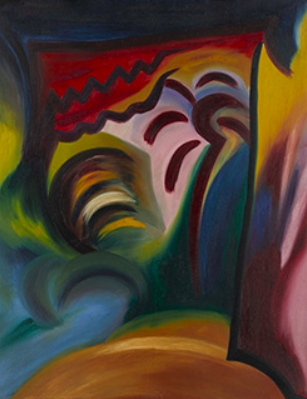
Kōshirō Onchi, Inspired by Scriabin’s Poem of Ecstasy, 1922. Collection of the National Museum of Modern Art, Tokyo.
A pioneering composer and conductor of modern Japanese music and the creator of songs including Karatachi no Hana and Akatombo, Yamada was also active in the visual and performing arts. After returning from Berlin, he co-organized the “Sturm Woodcut Exhibition” (1914) with Keizō Saitō, introducing European expressionism to Japan and influencing artists such asKōshirō Onchi and Kiyoshi Hasegawa. His magazine Shi to Ongaku (Poetry and Music, 1922–) and collaborations with Hakushū Kitahara, Yumeji Takehisa, and Onchi further reveal his integrative vision of sound and image.
Cultural Leadership and Wartime Responsibility
Yamada became one of the most influential figures in the development of modern music in Japan. He helped establish orchestras, promoted the work of Japanese composers, and composed symphonies, operas, film music, choral works, and songs.
His public career also became entangled with the Japanese state and its wartime institutions.
During the Asia-Pacific War, Yamada participated in Japan’s state-directed cultural mobilization. He became vice president of the Japan Music Culture Association in 1941 and later served as its president. Operating under the government’s Information Bureau, the association coordinated musical activity in support of the wartime state. Yamada also helped organize the Music Volunteer Corps, which performed for civilians and military personnel.
After Japan’s defeat in 1945, Yamada’s leadership in these organizations became the subject of public criticism. This history should not be minimized or separated from an assessment of his career.
Recognizing Yamada’s artistic achievements and examining his wartime participation are not contradictory. Both are necessary to understand the authority he acquired, the institutions he helped build, and the political uses to which music could be directed.
Legacy
Yamada’s Carnegie Hall appearances marked an important moment in the history of Japanese music in the United States. He entered the concert hall not as an anonymous representative of a timeless national tradition, but as a modern composer, conductor, and cultural intermediary.
At the same time, the reception of his music shows that cultural exchange does not take place on equal or neutral terms. New York audiences listened to Yamada’s compositions through racialized assumptions about Japan and through the political relationship between the two countries.
The significance of these concerts lies in that tension. They created new possibilities for Japanese musicians on the international stage while revealing the expectations and structures that continued to limit how their work could be heard.
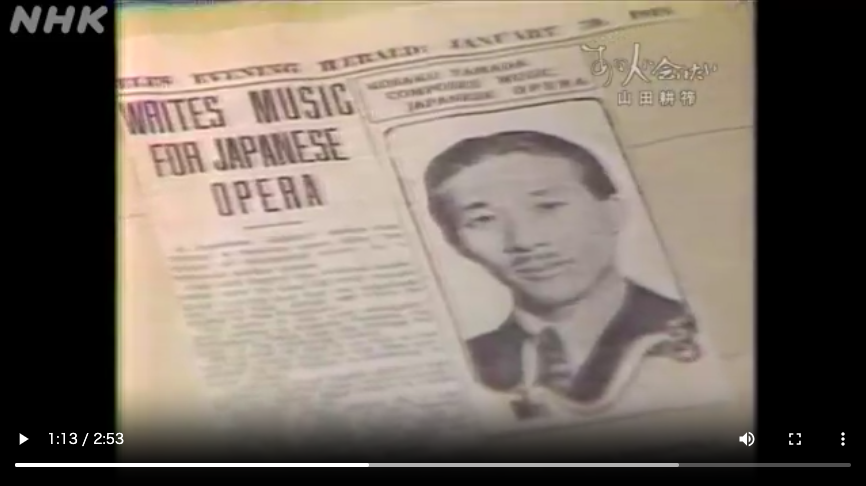
VIDEO: BIOGRAPHY OF YAMADA KŌSAKU
This archival biography surveys Yamada’s education, compositions, conducting career, institutional leadership, and contested wartime legacy.
Pacun, David. “‘Thus We Cultivate Our Own World, and Thus We Share It with Others’: Kósçak Yamada’s Visit to the United States in 1918–1919.” American Music 24, no. 1 (Spring 2006): 67–94.
This online exhibition was developed by the Digital Museum of the History of Japanese in New York as part of Carnegie Hall’s Spotlight on Japan.
Curator and Writer: Yuka Yokoyama Digital Humanities Project Manager and Web Production: Mac Gill
Archival and Image Sources: Carnegie Hall Susan W. Rose Archives; Library of Congress, Prints and Photographs Division; Tokyo University of the Arts Archive Center; Tochigi Prefectural Museum of Fine Arts; Chiyoda City Board of Education; Aichi Prefectural Museum of Art; The New York Times; and the Yamada Kōsaku and Akatombo Lovers Association website.
Individual image captions provide object-specific collection and source information.