UNFORGOTTEN STORIES

Japanese and Japanese Americans in New York During the 1940s

The history of Japanese and Japanese Americans in wartime New York is often overshadowed by the mass forced removal and incarceration that took place on the West Coast. New York was outside the military exclusion zone, but the war nevertheless transformed the city’s Japanese community.

After the attack on Pearl Harbor, the federal government arrested Japanese nationals in New York under the Enemy Alien Control Program and detained many of them at Ellis Island. Families lost income and community institutions lost leaders. At the same time, Japanese Americans arriving from West Coast incarceration camps sought education, employment, and housing in New York. Churches, political groups, relief organizations, artists, students, and community leaders responded to these disruptions in different and sometimes conflicting ways.

Unforgotten Stories examines four interconnected histories: detention at Ellis Island, organizing around democracy and wartime loyalty, educational relocation, and the rebuilding of community in New York and the surrounding region. The exhibition does not present these developments as a simple progression from hardship to triumph. Instead, it considers how people acted within the constraints of racism, surveillance, incarceration, displacement, and war.

Japanese New York Before Pearl Harbor

In the early twentieth century, New York’s Japanese community included diplomats and corporate employees, merchants, industrial and domestic workers, business owners, religious leaders, artists, and writers. Many were Issei who were barred by federal law from naturalized citizenship. A smaller American-born Nisei generation was also coming of age.

As relations between Japan and the United States deteriorated during the late 1930s, some Japanese companies reduced or closed their New York operations, and some employees and their families returned to Japan. Those who remained faced growing uncertainty about their legal status, employment, and position within the city.

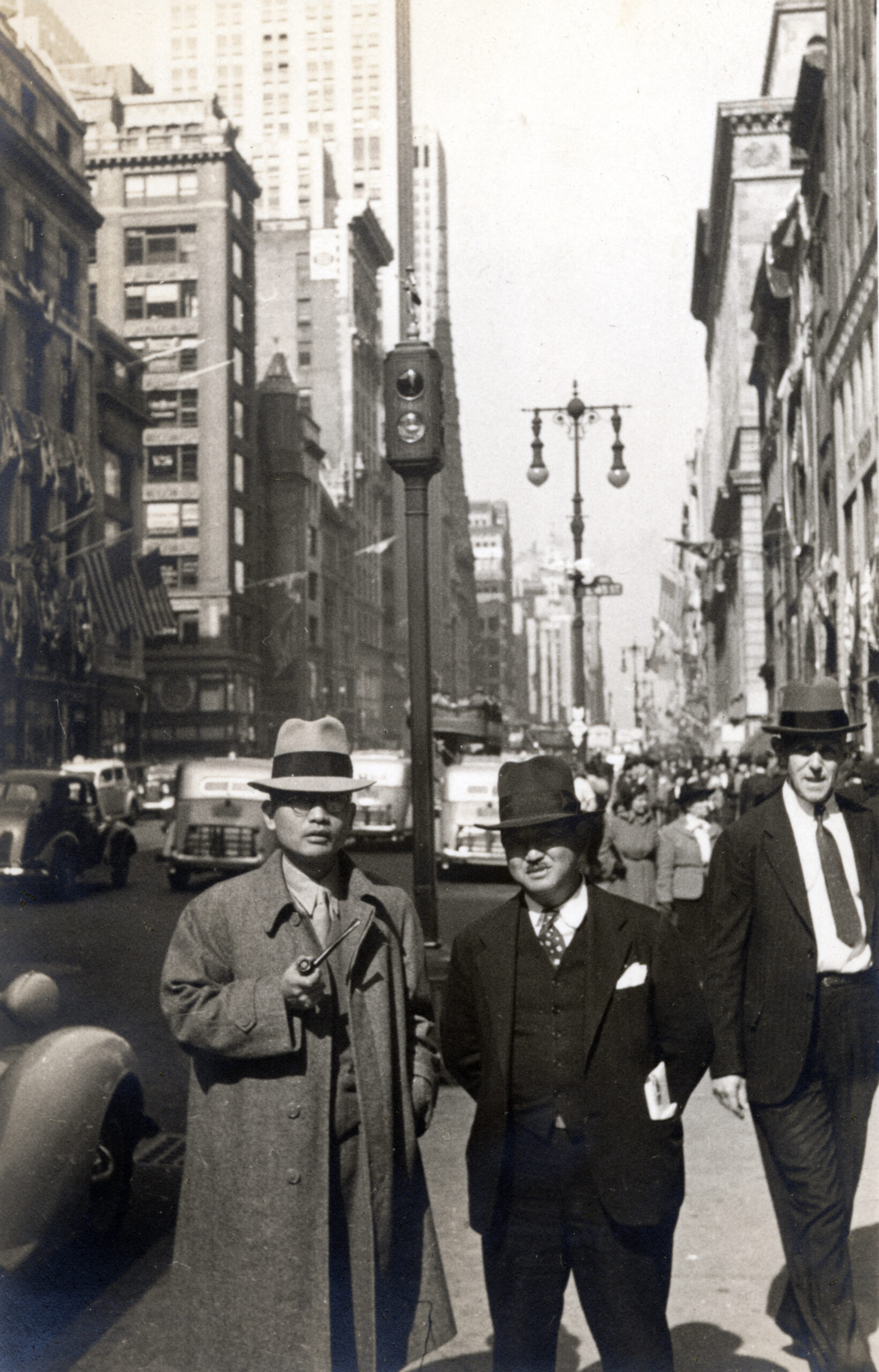
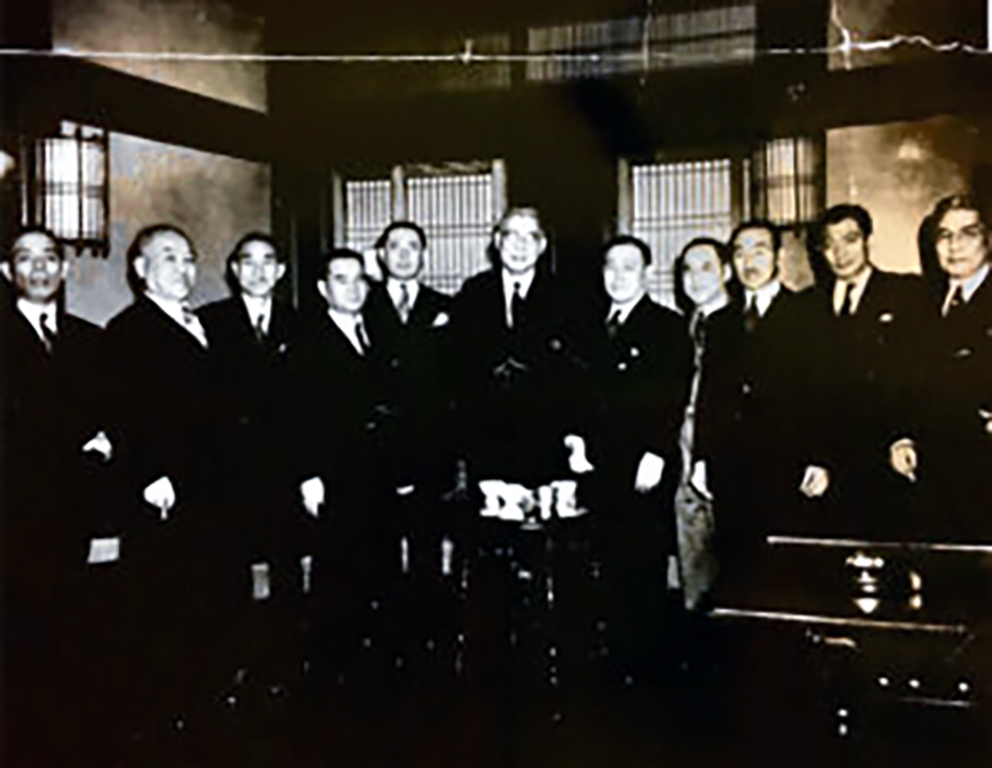
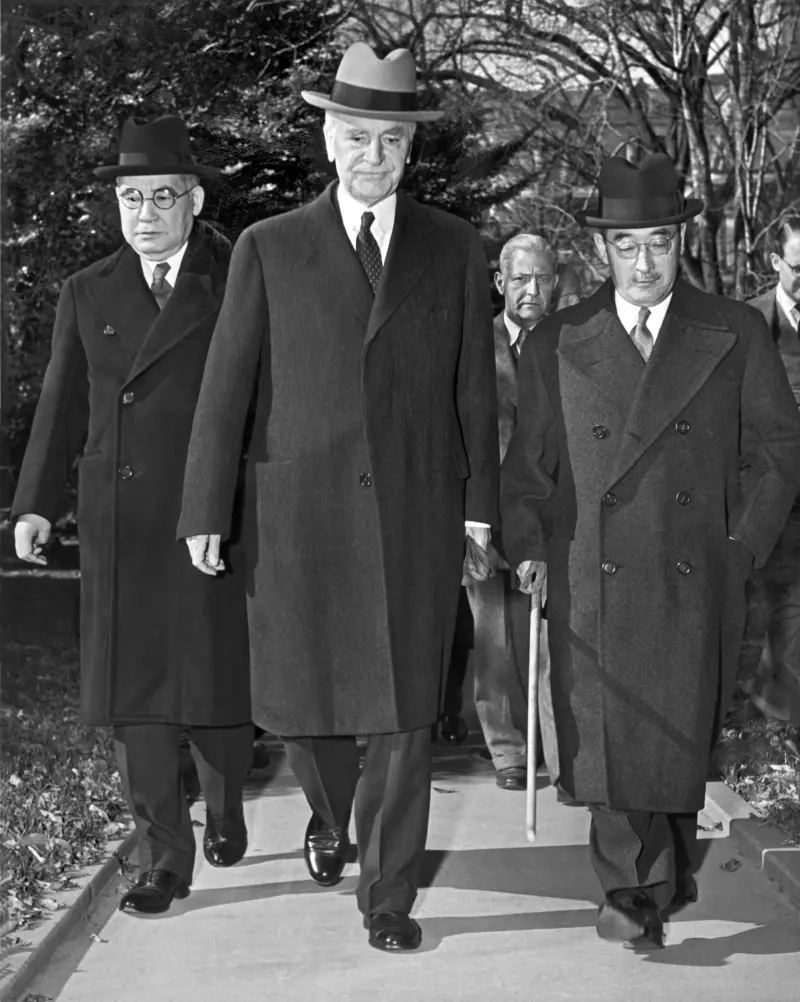
The connection between international diplomacy and local community institutions was visible in 1941. Kichisaburo Nomura was appointed Japanese ambassador to the United States on February 11. In Washington, D.C., he conducted negotiations with Secretary of State Cordell Hull as relations between the two countries worsened.

Nomura also visited New York. On March 3, 1941, the Japanese Association of New York held a reception for him at the Nippon Club. The gathering brought the ambassador together with leading members of the city’s Japanese business and community organizations. Within a year, many of those institutions would be closed or weakened, and some of their leaders would be in federal custody.

Enemy Alien Detention in New York

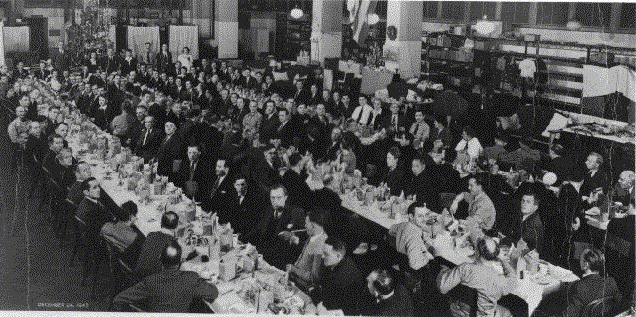
German American and Japanese American internees gathered in the Great Hall at Ellis Island, 1943. United States Holocaust Memorial Museum Collection, Gift of Arthur Jacobs. © Arthur D. Jacobs.

Following the attack on Pearl Harbor on December 7, 1941, Presidential Proclamation 2525 authorized restrictions on Japanese nationals classified as enemy aliens. Federal agents arrested religious leaders, businesspeople, journalists, professionals, and others whom the government considered potential security risks. Because Japanese immigrants had been legally excluded from naturalization, long residence in the United States did not protect Issei from enemy-alien classification.

These arrests were legally and administratively distinct from the mass forced removal from the West Coast. President Franklin D. Roosevelt signed Executive Order 9066 on February 19, 1942. The order enabled the removal and incarceration of more than 120,000 people of Japanese ancestry, approximately two-thirds of whom were United States citizens. New York was outside the West Coast exclusion zone, but Japanese nationals in the city were still subjected to surveillance, searches, restrictions on travel and property, arrest, and detention.

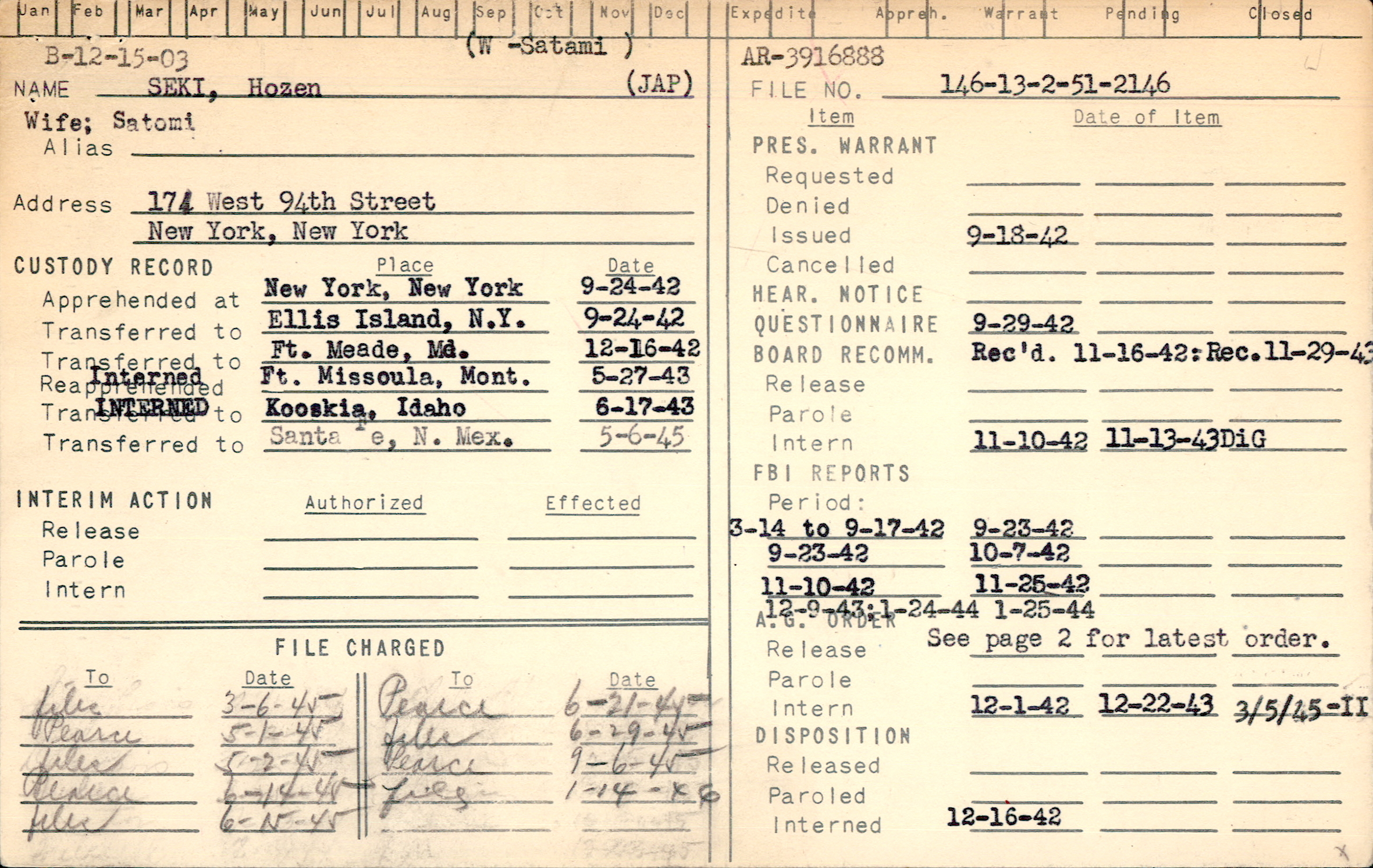
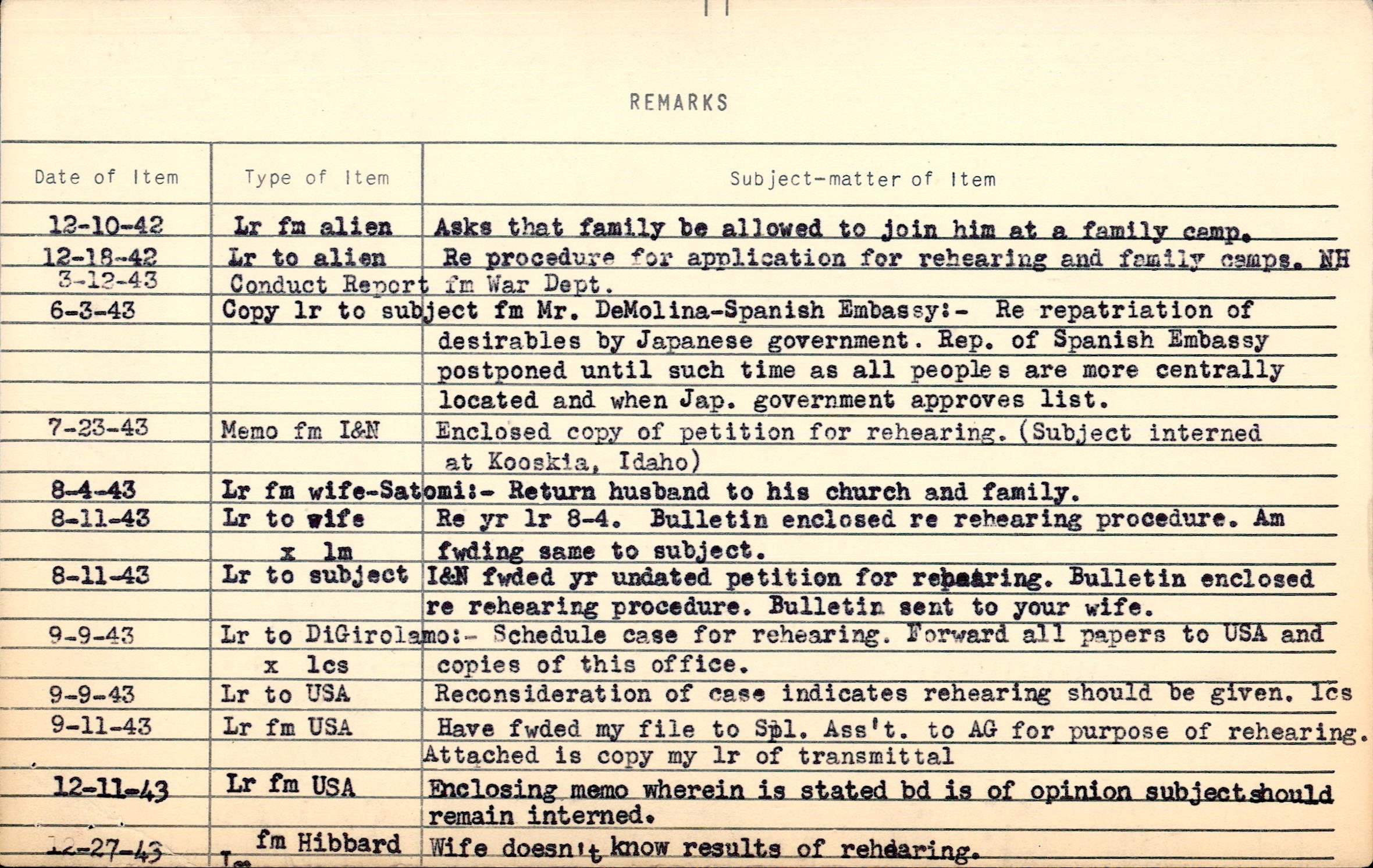
Historian Anna Pegler-Gordon’s research, based on Department of Justice records held by the National Archives and Records Administration, including the World War II Japanese Internee Cards, 1941–1947, has identified at least 440 Japanese nationals who were held at Ellis Island during the war. Existing records indicate that four of them were women. Naoye Suzuki, a U.S.-born Nisei and United States citizen, was also detained there. Hearing boards recommended parole, continued confinement, transfer to another Justice Department facility, or repatriation. Some detainees were released to approved sponsors and required to report to federal authorities. Others were transferred to Fort Meade, Fort Missoula, Kooskia, Santa Fe, and other facilities.

Ellis Island therefore served a different function from the War Relocation Authority camps in the West. It was a detention and hearing facility where Japanese New Yorkers waited to learn whether they would be released, transferred, or sent to Japan. The system disrupted households and institutions even when an individual’s detention lasted only weeks or months.

Hozen Seki: A Congregation Without Its Minister

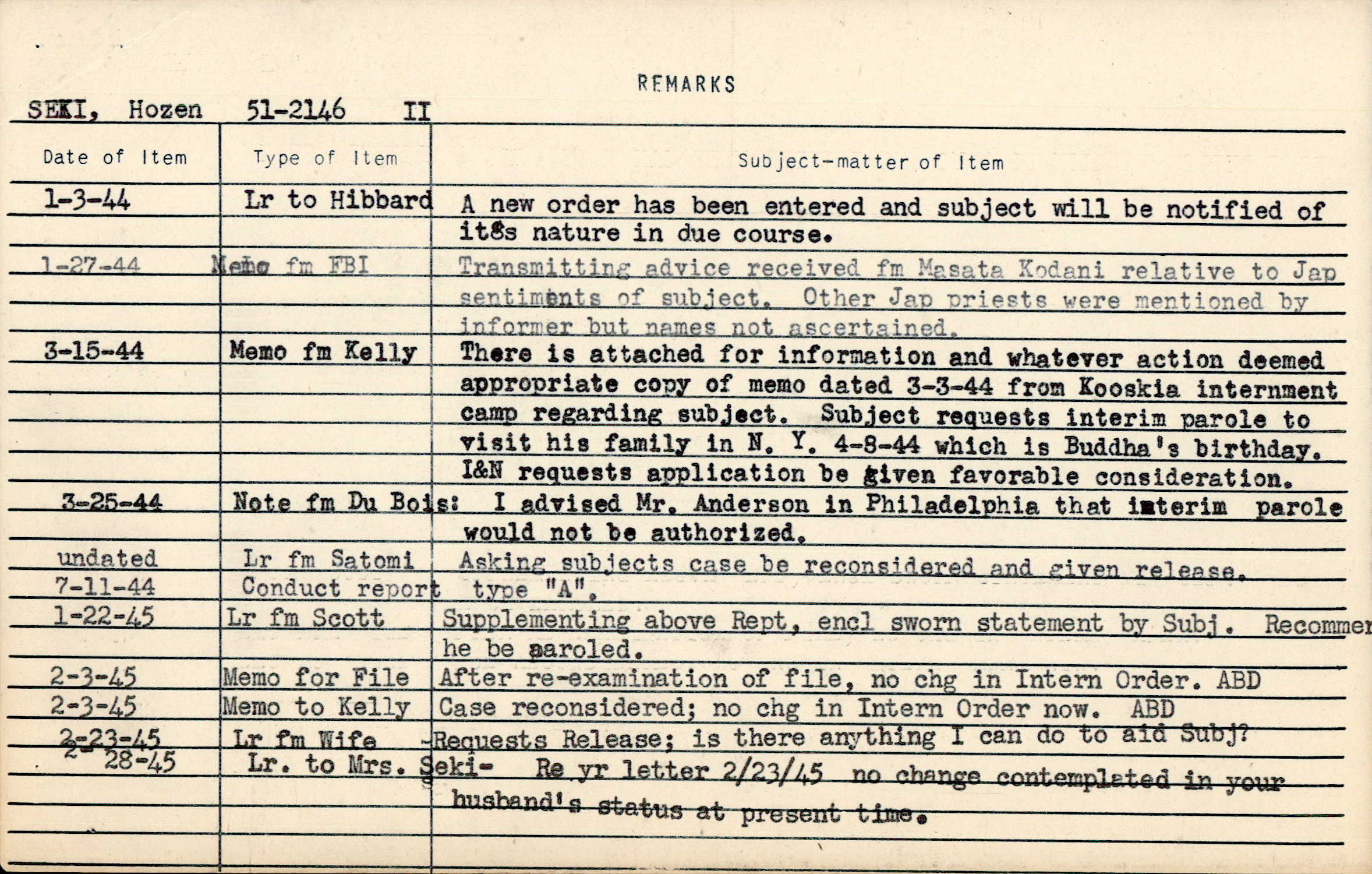
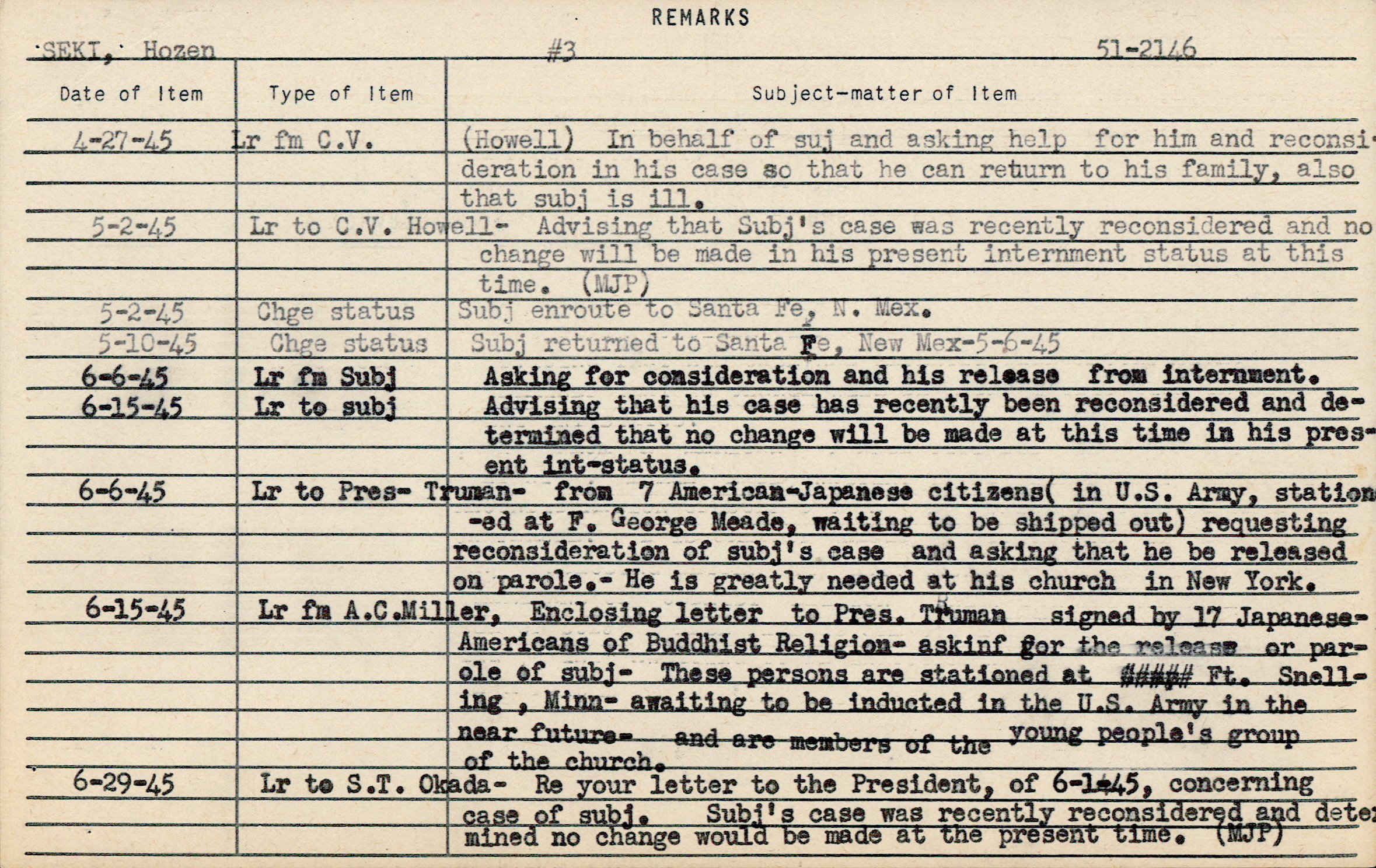
Rev. Hozen Seki, founder of the New York Buddhist Church, was detained at Ellis Island and transferred among Fort Meade, the Kooskia road camp in Idaho, and Santa Fe. His detention removed a religious leader from a congregation that depended on him during a period of fear and uncertainty.

In his absence, Seki’s wife, Satomi, helped sustain the church and its congregation. The church offered spiritual and social support and became a gathering place for Japanese American servicemen, including members of the 442nd Regimental Combat Team, before their deployment to Europe. Seki’s story shows that detention affected more than the person in custody. It also altered the lives of spouses, children, congregations, and other people who relied upon community institutions.

Letter from Fumiyo Kozai to friends before the family’s departure for Japan, c. early 1940s. Courtesy of the Kozai Family Collection, JAA Archive.

Jiro Kozai: Detention, Family, and Repatriation

Jiro Kozai was a writer, editor, and publisher of the Japanese-language newspaper The Japanese American. He had served as president of the Japanese Association of New York and helped mobilize local support for the Japanese Pavilion at the 1939 New York World’s Fair. After Pearl Harbor, he was detained at Ellis Island and Camp Upton.

Kozai was later repatriated to Japan with his Nisei wife, Fumiyo, and daughters. Their departure demonstrates how wartime detention and repatriation decisions could determine the future of an entire family, including family members who were United States citizens.

Other New Yorkers in Federal Custody

The detention program reached across professional and community life. Physician Kuro Murase was held at several federal facilities before being repatriated to Japan in September 1945. Dr. Sabro Emy, who treated many Japanese-speaking working-class patients, was released under restrictions and remained subject to federal monitoring.

Architect Yasuo Matsui (1883–1962) was detained at Ellis Island and faced reporting and travel restrictions after his release. Landscape architect Takeo Shiota (1881–1943), designer of the Japanese Hill-and-Pond Garden at the Brooklyn Botanic Garden, died in 1943 after being transferred from Ellis Island to federal custody in South Carolina. Artist and architectural photographer Yosei Amemiya (1888–1977) remained in custody despite outside appeals for his release.

These brief profiles are not interchangeable stories. Their experiences differed according to citizenship, profession, family circumstances, hearing-board decisions, and government classifications. Together, however, they demonstrate how federal detention removed people who had helped sustain New York’s medical, religious, cultural, and civic institutions.

Japanese Internment Report by the American Friends Service Committee, NY Office. Courtesy of AFSC Archive.

Families and Institutions Left Behind

Many detainees had been principal wage earners. Their spouses and children faced lost income, housing insecurity, disrupted education, and uncertainty about whether separated relatives would be released, transferred, or sent to Japan. Religious and private organizations, including the Federal Council of Churches of Christ in America and the American Friends Service Committee, assisted some families with food, housing, employment, and parole sponsorship.

Detention also changed the structure of community leadership. Prewar organizations representing Japanese nationals were closed or weakened. New groups emerged to address discrimination, employment, civil rights, wartime loyalty, and the arrival of Japanese Americans from the West Coast incarceration camps.

Organizing Before and After Pearl Harbor

“Japanese American Committee for Democracy Newsletter, vol. 2, no. 2 (November 1943).” Courtesy of the Occidental College Library Special Collections

Political and social-service organizing in New York began before the United States entered the war. In August 1940, Issei and Nisei activists, religious leaders, artists, and journalists organized the Committee for the Democratic Treatment of Japanese Residents in the Eastern States. Rev. Alfred Saburo Akamatsu (1904–1981), pastor of the Japanese Methodist Church of New York, became its first president.

The committee assisted people who had lost employment as Japanese companies reduced their American operations, contacted churches and government agencies about relief, studied local social-service needs, and protested discrimination. After Pearl Harbor, the Japanese Consulate closed and federal authorities arrested Akamatsu and other Issei leaders.

A public meeting attended by approximately 150 people led to the formation of the Japanese American Committee for Democracy (JACD). Thomas Komuro was elected chair, six subcommittees were established, and the organization began publishing a newsletter. Its advisory board included Pearl S. Buck, Albert Einstein, and Franz Boas.

The JACD operated within a difficult and sometimes contradictory political environment. It protested racial discrimination and assisted Japanese Americans with employment, housing, and resettlement. It also publicly supported the United States war effort and condemned Japanese militarism. These positions reflected antifascist commitments, but they also developed under intense pressure on people of Japanese ancestry to demonstrate loyalty.

Nori Ikeda Lafferty. Courtesy of Richard Bermack and J. Paul Leonard Special Collection Library, San Francisco State University

Nori Ikeda Lafferty and a Change in Leadership

In early 1943, Nori Ikeda Lafferty became the JACD’s first paid staff member. A Nisei activist from California, she arrived as increasing numbers of formerly incarcerated Japanese Americans were moving east. Her work helped expand the JACD’s employment, housing, political, and social programs and encouraged other Nisei activists to relocate to New York.

By 1944, the organization’s leadership had shifted. Issei board members resigned and Nisei members assumed a larger role. This transition reflected a broader transformation of Japanese New York. A community that had been composed primarily of Japanese immigrants before the war was increasingly shaped by American-born Japanese Americans arriving from the West Coast.

Lafferty’s story places organizational labor, rather than later fame, at the center of this history. The JACD depended upon people who answered letters, located rooms and jobs, edited newsletters, organized meetings, and connected newcomers with existing networks.

Artists, Propaganda, and Wartime Choice

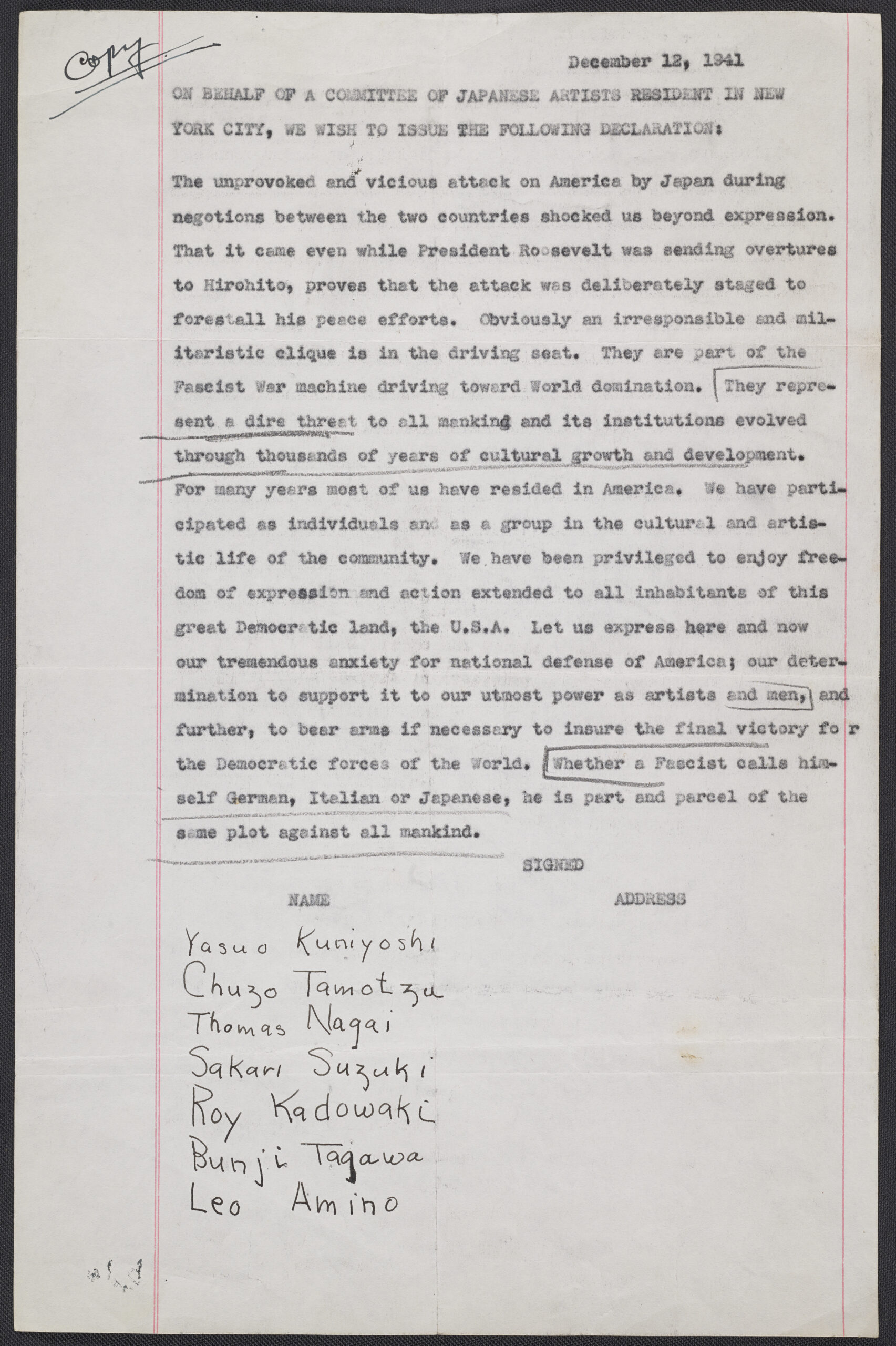
Artists formed a visible part of JACD activity. Leo Amino (1911–1989), Yasuo Kuniyoshi (1889–1953), Isamu Noguchi (1904–1988), and others participated in the Arts Council of Japanese Americans for Democracy.

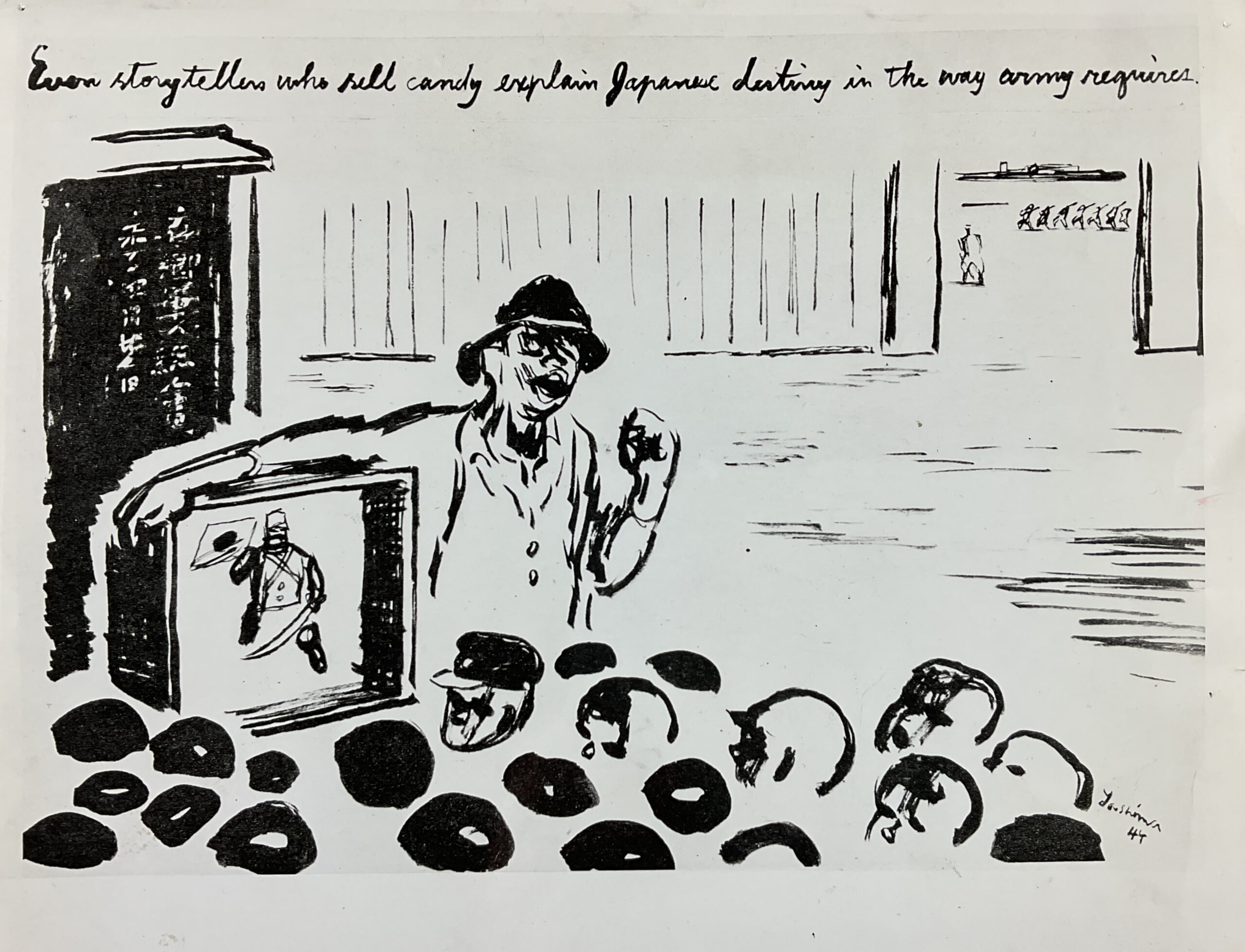
In December 1941, Amino, Kuniyoshi, Chuzo Tamotzu, Noguchi, Thomas Nagai, Roy Kadowaki, Sakari Suzuki (1899–1995), and Bunji Tagawa signed a declaration condemning Japanese militarism. Taro Yashima (1908–1994) later produced visual materials for the Office of War Information and the Office of Strategic Services.

Kuniyoshi produced pro-Allied propaganda and war-bond imagery and delivered a Japanese-language radio address for the Office of War Information. Chuzo Tamotzu (1888–1975) worked for the Office of Strategic Services in Southeast Asia. Noguchi, who lived in New York and was not subject to the West Coast exclusion order, entered the Poston incarceration camp voluntarily in an effort to develop arts and community programs. He soon encountered the restrictions of camp administration and returned to New York several months later.

These artists did not share a single wartime experience. Their actions reflected political conviction, professional opportunity, personal history, and the constraints imposed upon people of Japanese ancestry. Their work should not be described simply as “anti-war art.” Much of it was explicitly pro-Allied propaganda produced within the American wartime information system.

Resettlement Work

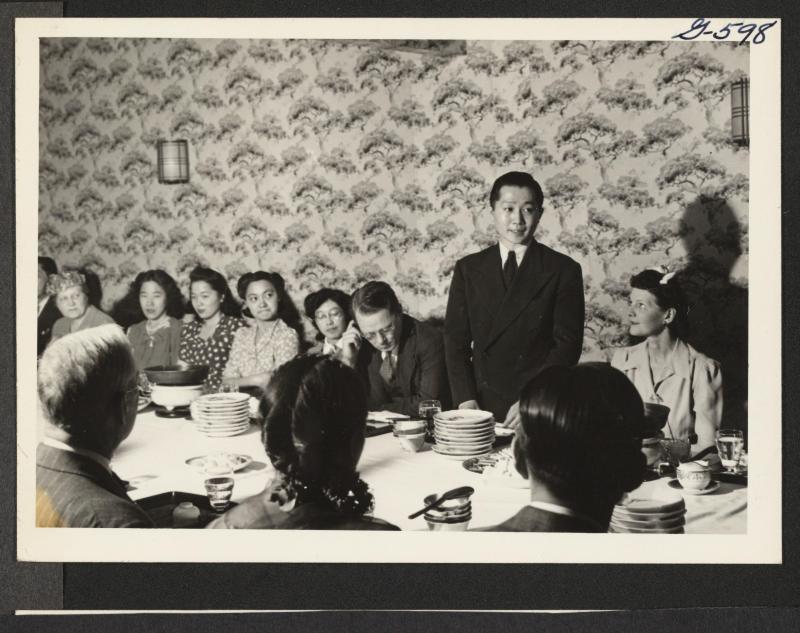
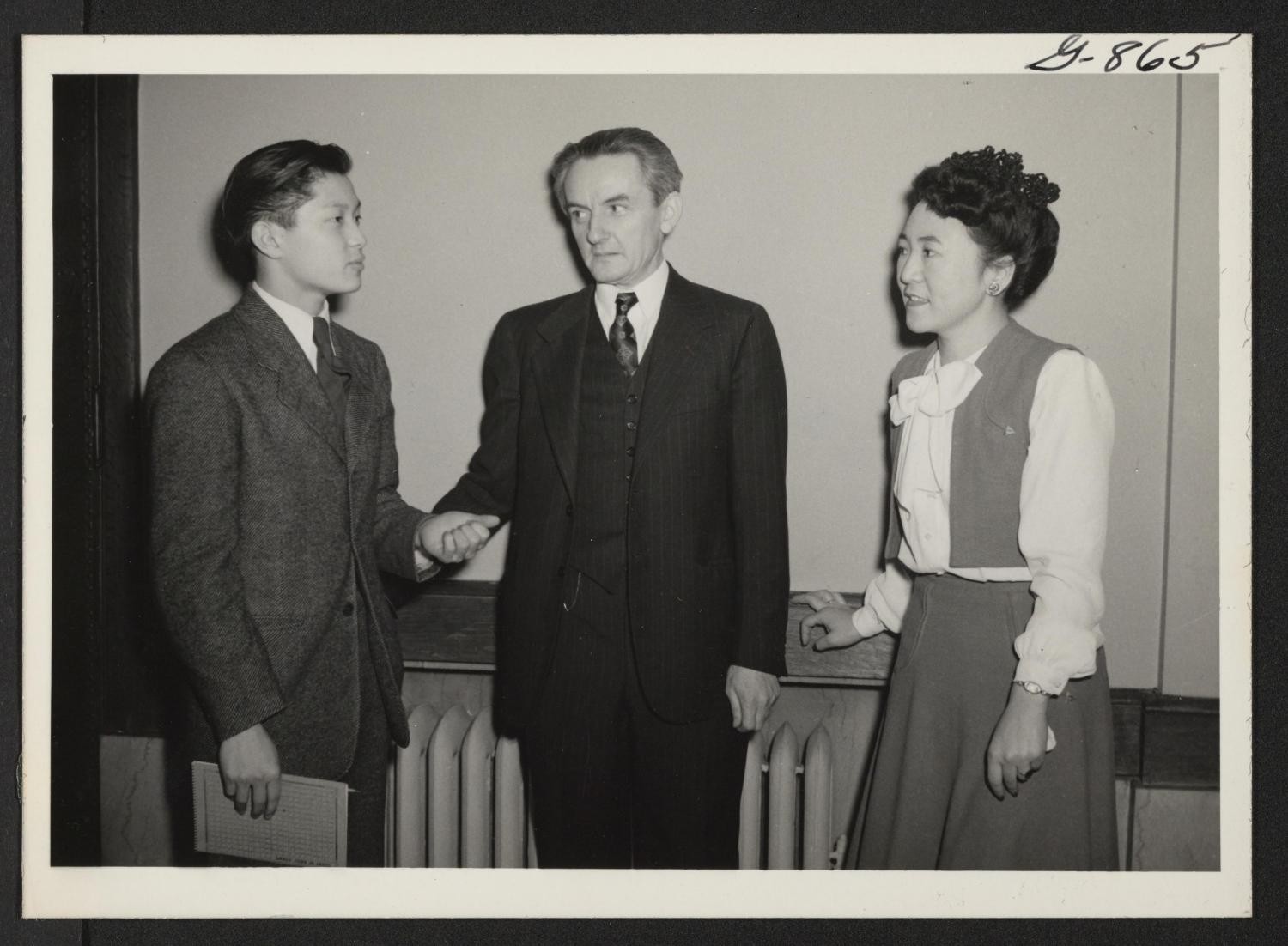
Architect Minoru Yamasaki (1912–1986) served as a vice chair of the Arts Council of Japanese Americans for Democracy and chaired the Resettlement Council of Japanese American Organizations in New York. The council assisted Japanese Americans leaving West Coast incarceration camps, many of whom arrived in the city without secure housing, employment, or established community ties.

In 1944, Yamasaki supported the opening of a hostel in Brooklyn for newly arrived Japanese Americans despite opposition from local residents and public officials. His wartime work reveals a lesser-known chapter of his life: before achieving international recognition as an architect, he helped displaced Japanese Americans establish new lives in New York.

Minoru Yamasaki speaks at a dinner at Miyako Restaurant honoring Harold Fistere, the War Relocation Authority’s relocation supervisor for the Middle Atlantic region. Yamasaki chaired the Resettlement Council of Japanese American Organizations in New York and represented the Arts Council of Japanese Americans for Democracy. Courtesy of the Bancroft Library, University of California, Berkeley.

Statement of the Arts Council of Japanese Americans for Democracy, Yasuo Kuniyoshi, Chairman, February 11, 1944. Courtesy of the Smithsonian Institution Archives.

Women’s Public Voices

Women also shaped political education and public communication. Ayako Ishigaki, an Issei journalist, feminist, and author of Restless Wave (1940), began working for the Office of War Information in 1942. She and her husband, artist Eitaro Ishigaki (1893–1958), remained subject to enemy-alien restrictions and employment losses despite their opposition to Japanese militarism.

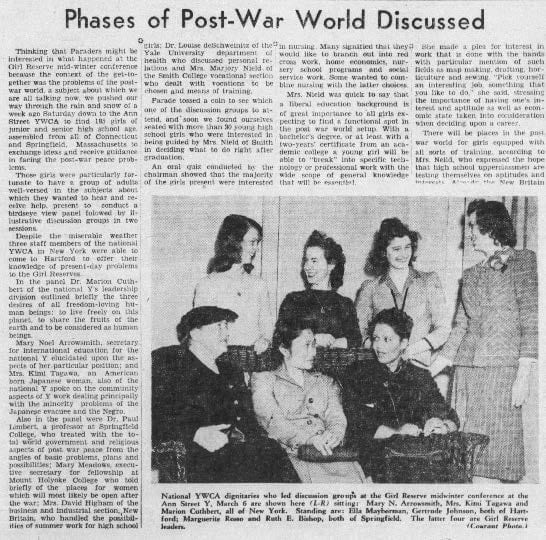
Kimi Gengo Tagawa wrote stories for The Bookshelf, a YWCA Girl Reserve publication. Through fictional conversations, she introduced young readers to immigration, American and Japanese culture, race, and belonging. Ishigaki and Tagawa demonstrate that wartime political work also took place through writing, religious organizations, education, and youth programs.

"Phases of Post-War World Discussed." Photo of National YWCA dignitaries at the Girl Reserve midwinter conference in 1943, including Kimi Gengo Tagawa (front row, center). Mrs. Kimi Tagawa, an American born Japanese woman, also of the national spoke on the community aspects of work dealing principally with the minority problems of the Japanese evacuee and the Negro. Courtesy of Hartford Courant/TCA, March 14, 1943

The JACD did not resolve the contradictions between civil-rights advocacy and support for wartime government policy. Its history is important precisely because it shows Japanese New Yorkers debating how to oppose racism, assist displaced people, and claim democratic rights while the United States was incarcerating people of Japanese ancestry.

Leaving Camp for School

Japanese Student Relocation, An American Challenge, 1942. Courtesy of American Friends Service Committee

The forced removal of Japanese Americans from the West Coast interrupted the education of thousands of students. In March 1942, educators and community leaders in Berkeley formed a committee that helped approximately seventy-five students transfer to institutions outside the military exclusion zone. In May, Clarence Pickett of the American Friends Service Committee helped establish the National Japanese American Student Relocation Council.

The council identified colleges and universities willing to accept Japanese American students, raised funds, and negotiated with government agencies for permission to leave assembly centers and incarceration camps. Admission to a college did not by itself guarantee release. Students also faced government screening, travel restrictions, tuition costs, housing shortages, and institutional prejudice.

The program offered an important route out of incarceration, but it was not a remedy for forced removal. Students often left parents and siblings behind, and the freedom available to them remained conditional.

How to Help Japanese American Student Relocation, published by the National Student Relocation Council, 1943. Courtesy of AFSC.

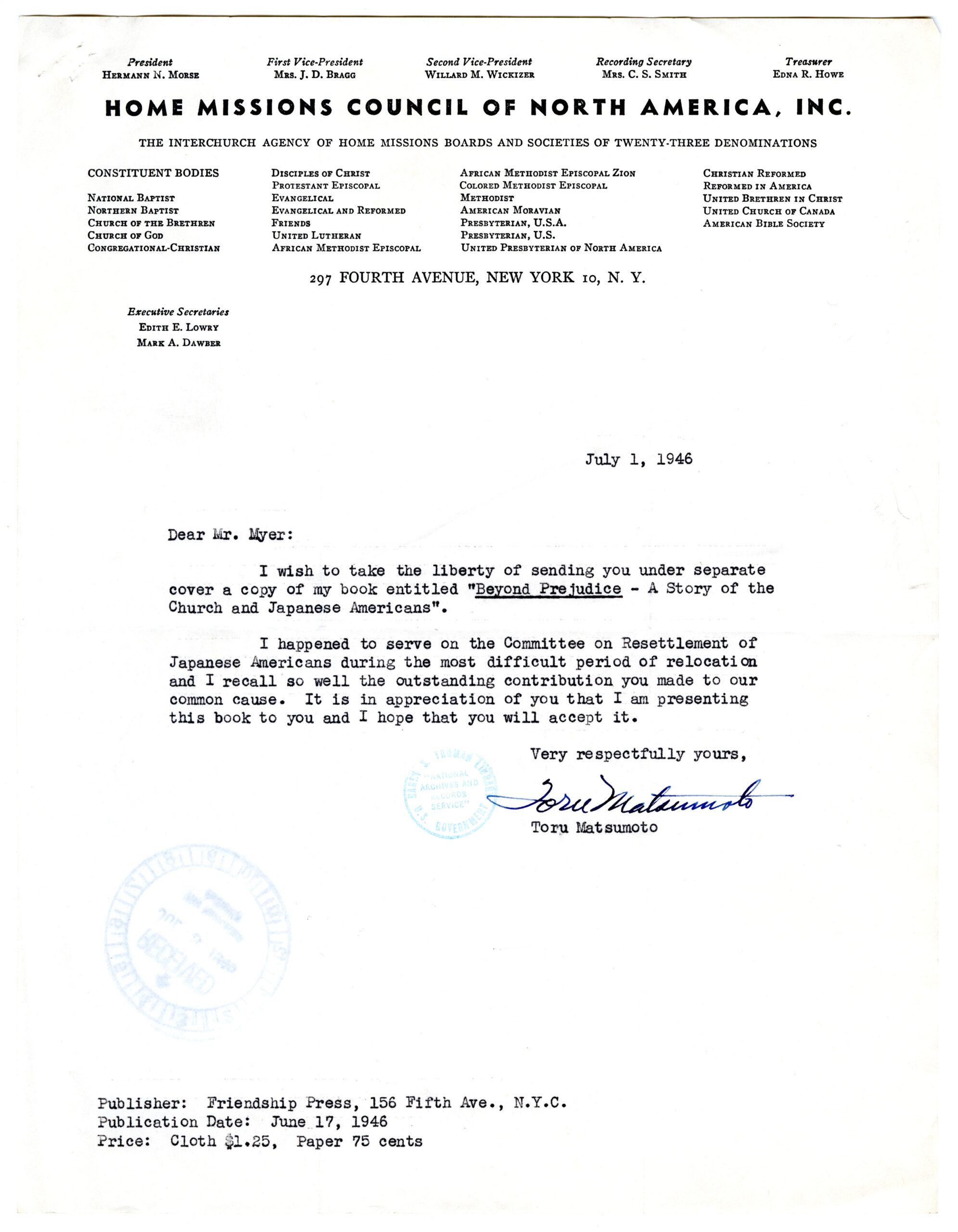
Letter from Toru Matsumoto to War Relocation Authority director Dillon S. Myer, 1946. Courtesy of the National Archives and Records Administration.

Toru Matsumoto: Connecting Camps, Churches, and Colleges

Toru Matsumoto (1913–1979) was detained at Ellis Island, Camp Upton, and Fort Meade. Following his release in late 1942, he became executive assistant to George E. Rundquist of the Committee on Resettlement of Japanese Americans, which was supported by Protestant church organizations.

Matsumoto served as general secretary of the Japanese Student Christian Association and collaborated with the World Student Service Fund. New York’s broader Christian network also included the Japanese American Christian Association. Matsumoto visited incarceration camps, raised funds, and encouraged students to pursue educational opportunities outside the camps. His work connected student relocation with church-based efforts to secure employment, housing, and other forms of resettlement assistance.

Matsumoto’s movements connected the East Coast detention system, national religious networks, incarceration camps, and New York educational institutions. His work demonstrates how religious and educational organizations helped Japanese Americans navigate the difficult transition from confinement to resettlement. His memoir, A Brother Is a Stranger (1946), provided an early published account of his wartime confinement and its consequences.

Students Arriving in New York

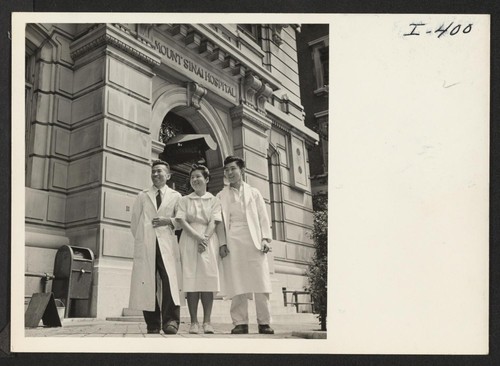
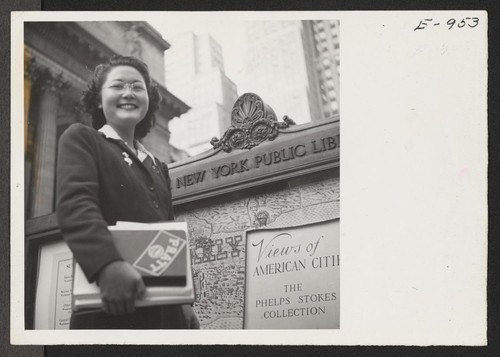
Institutions across New York State participated in student relocation. They included Alfred University, Bard College, Barnard College, Cornell University, Hunter College, New York University, Pratt Institute, the New School for Social Research, Teachers College, Union Theological Seminary, the University of Rochester, Vassar College, and other professional and secondary schools. A wartime survey published by Robert W. O’Brien recorded more than 320 students relocated to New York and more than 500 to the broader East Coast between 1942 and 1946.

Their experiences extended beyond classrooms. Students sought housing and employment, joined churches and civic organizations, and encountered a city in which anti-Japanese discrimination coexisted with interracial and interfaith organizing.

New York University enrolled more than a dozen Japanese American students under Chancellor Harry Woodburn Chase, an advocate of academic freedom and racial and religious tolerance. Mitsuye Yamada, then Mitsuye Yasutake, studied at NYU during the war. She later became a poet, essayist, feminist, and civil-rights activist whose writing addressed incarceration and Japanese American identity.

A Wartime Traveling Art Exhibition

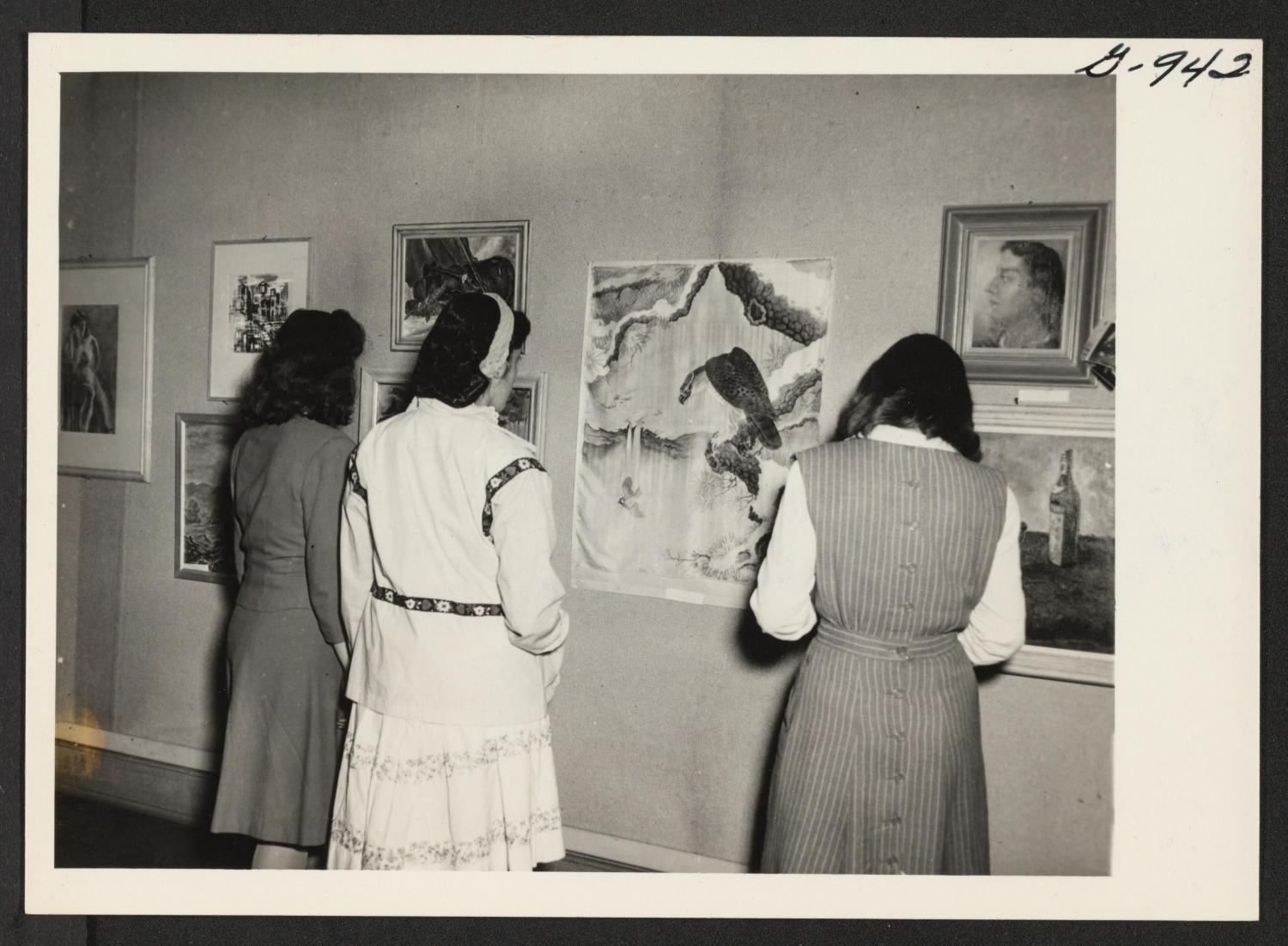
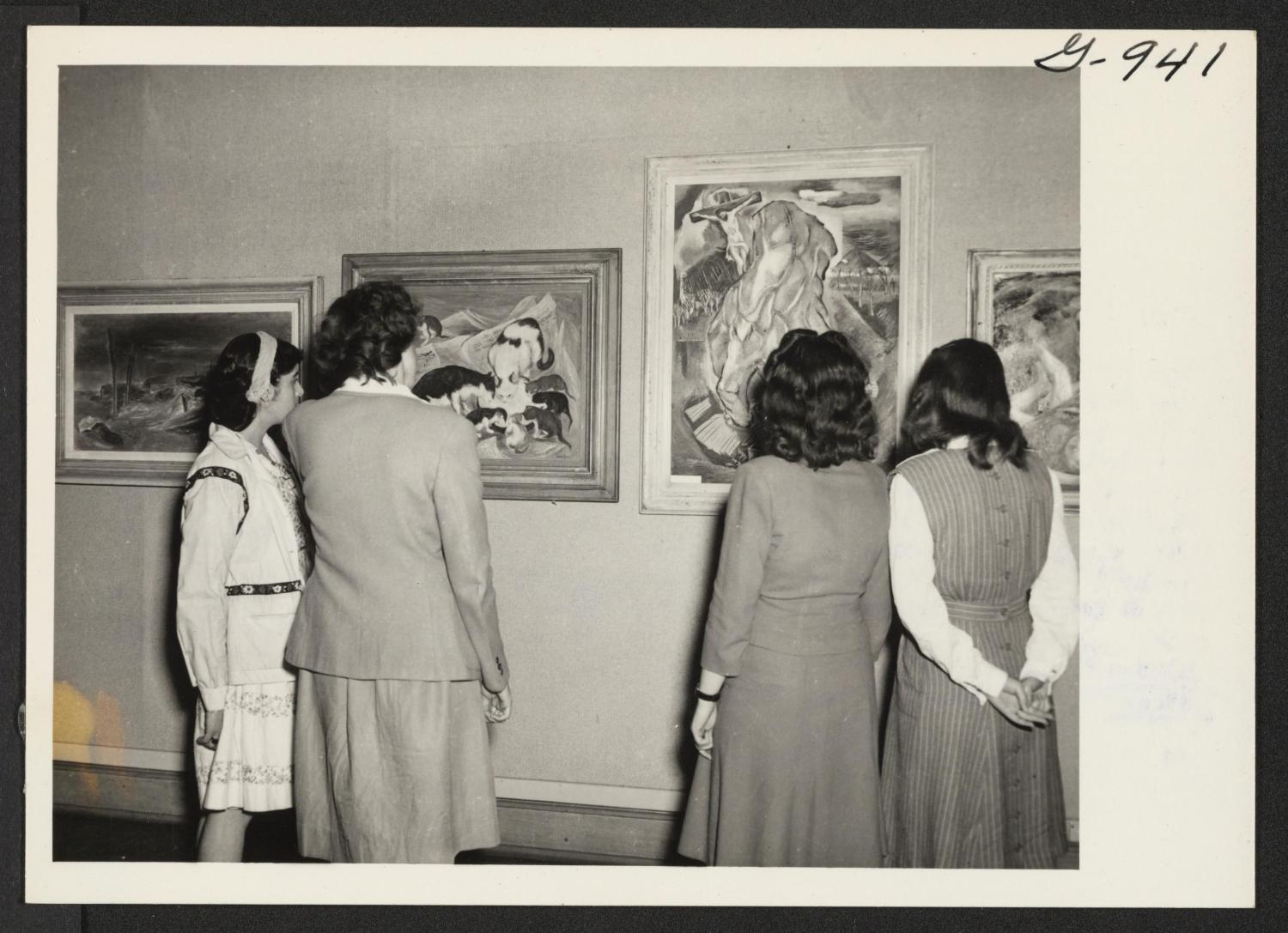
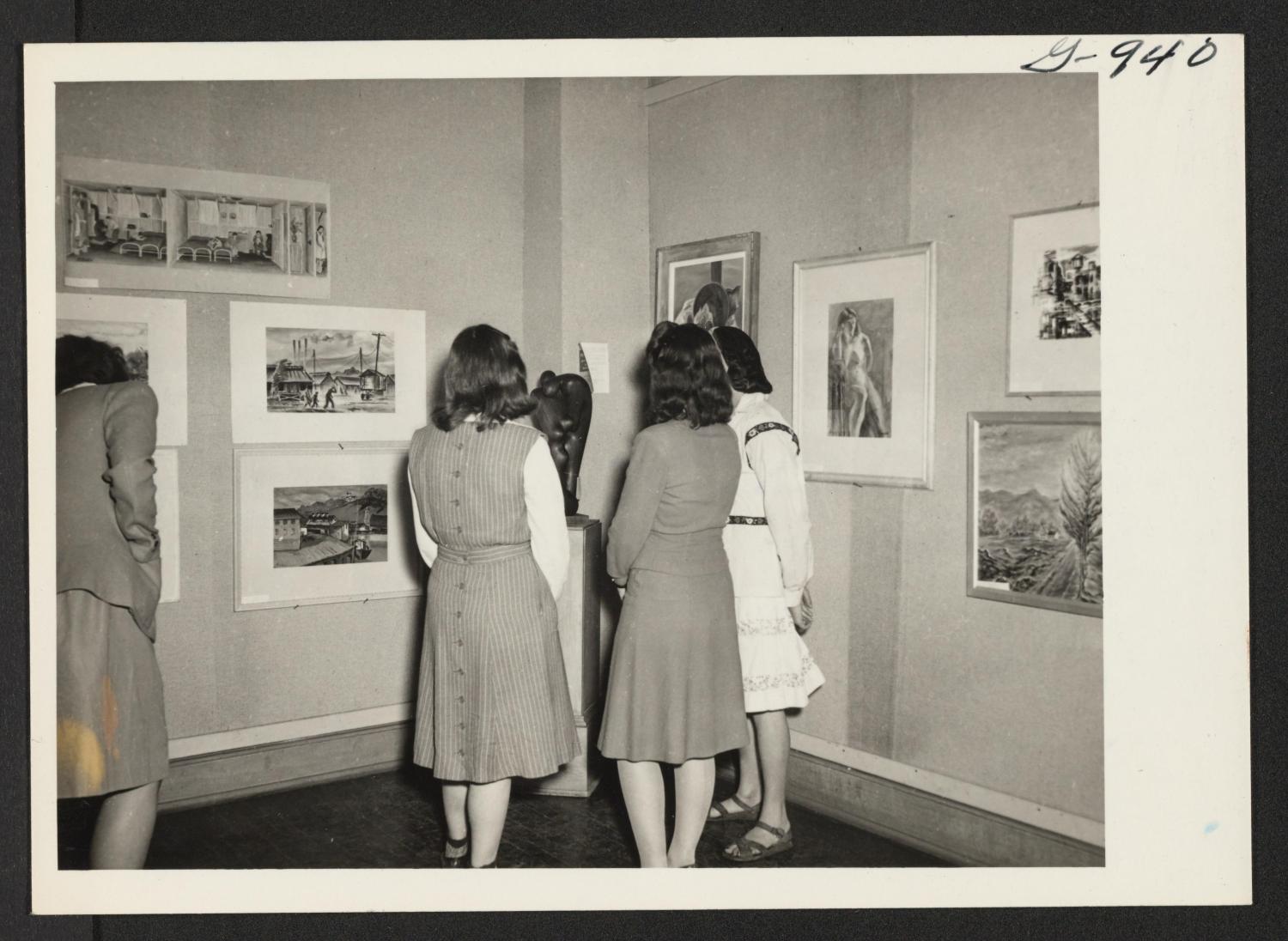
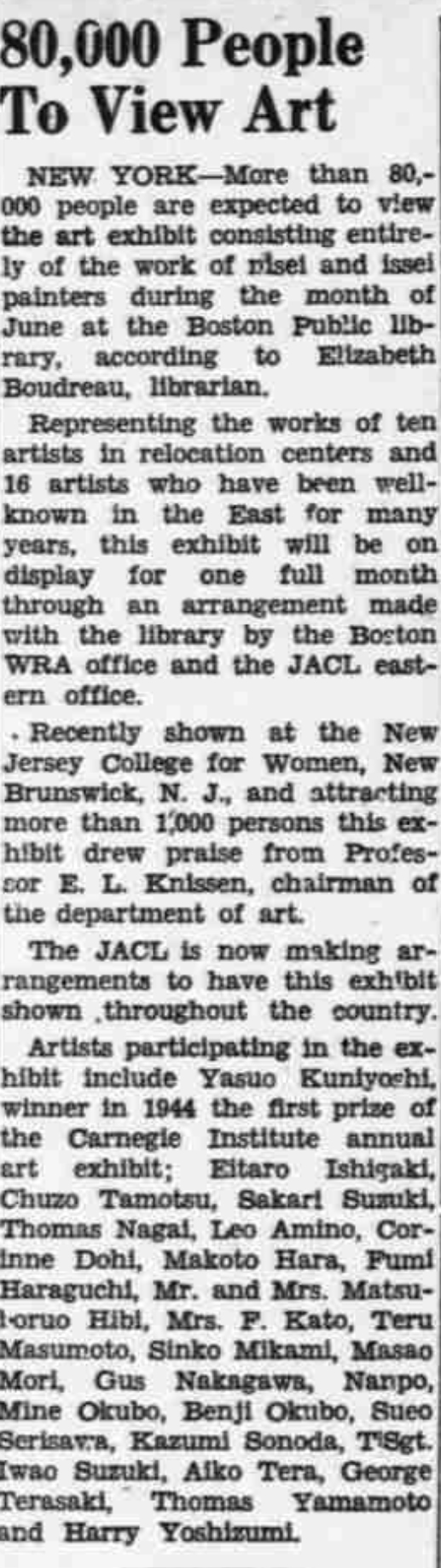
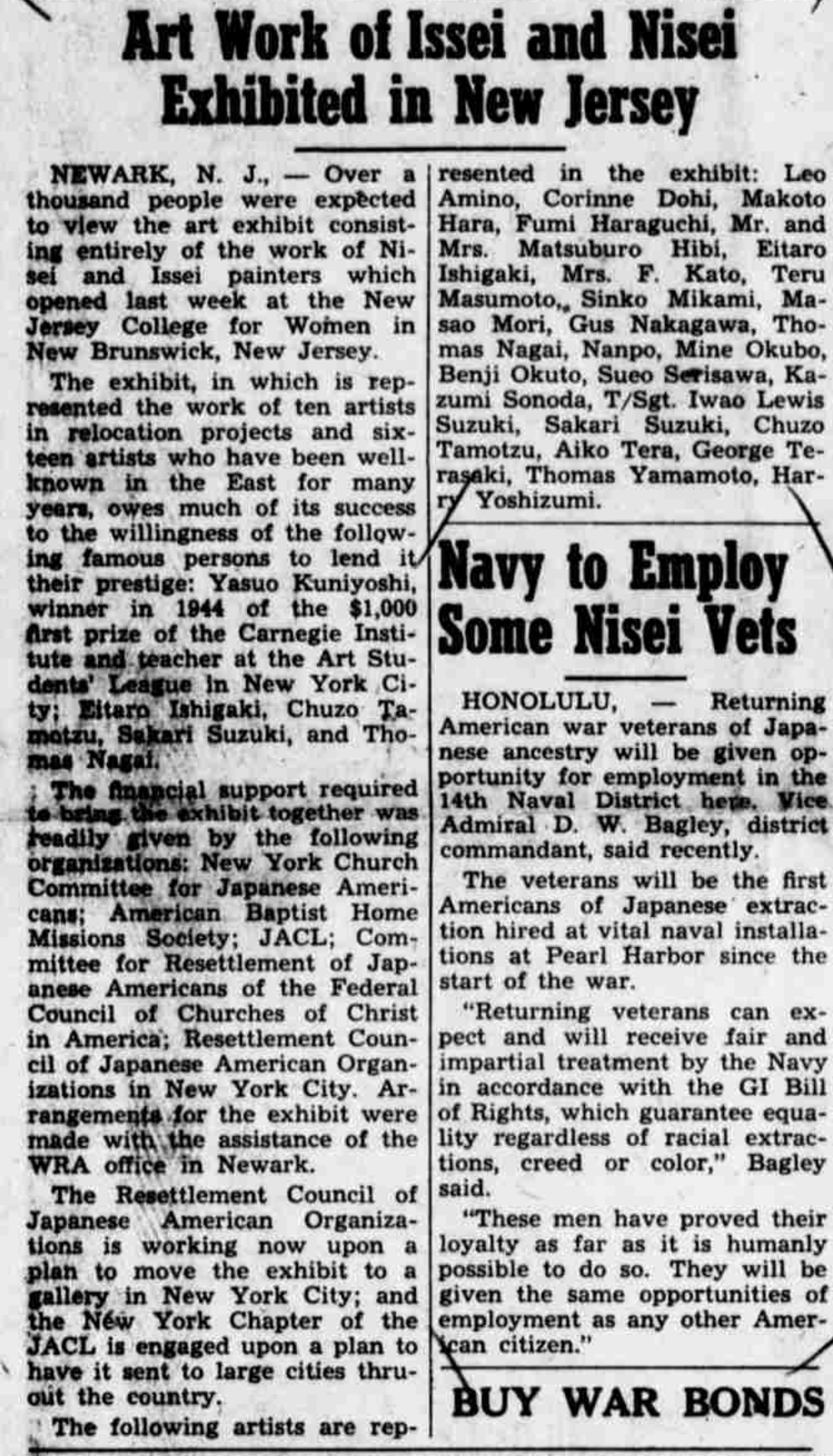
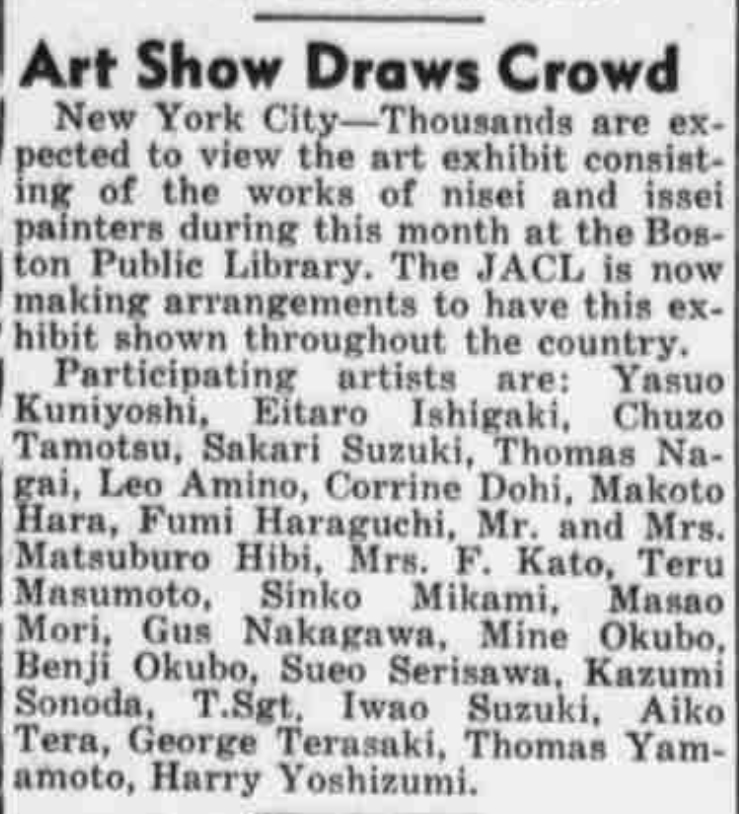
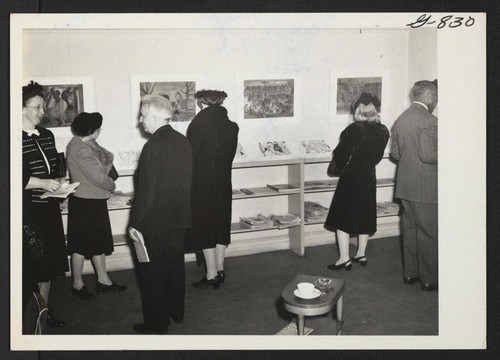
In May 1945, an exhibition of paintings and sculptures by Issei and Nisei artists opened at the New Jersey College for Women in New Brunswick. It brought together works by ten artists then living in War Relocation Authority “relocation projects,” the government’s term for the incarceration camps, and sixteen artists who had been well known in the East for many years. More than 1,000 people attended the New Brunswick presentation before the exhibition went on tour.

The exhibition was supported by a number of religious and Japanese American organizations, including the New York Church Committee for Japanese Americans, the American Baptist Home Missions Society, the Japanese American Citizens League (JACL), the Committee for Resettlement of Japanese Americans of the Federal Council of Churches of Christ in America, and the Resettlement Council of Japanese American Organizations in New York City. The Newark office of the War Relocation Authority assisted with arrangements for the exhibition. Following its presentation at the New Jersey College for Women, the Resettlement Council sought a New York venue, while the New York chapter of the JACL helped develop plans for the exhibition to travel to other cities.

Education, Work, and Creative Life

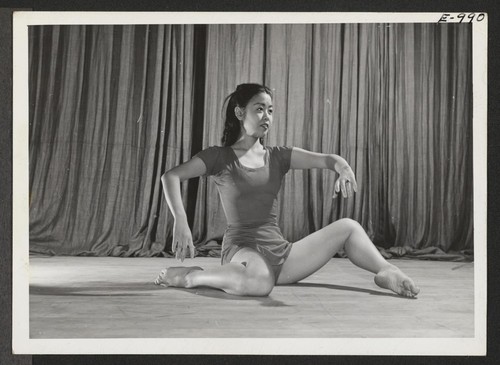
Education and employment often proceeded together. Yuriko Kikuchi had taught dance to children at the Gila River camp. After moving east, she worked in Manhattan’s garment industry while studying at the Martha Graham School. Her experience illustrates the practical demands placed upon young resettlers whose professional training continued while their families remained dispersed or incarcerated.

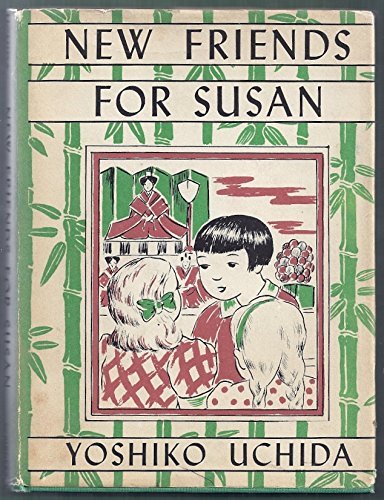
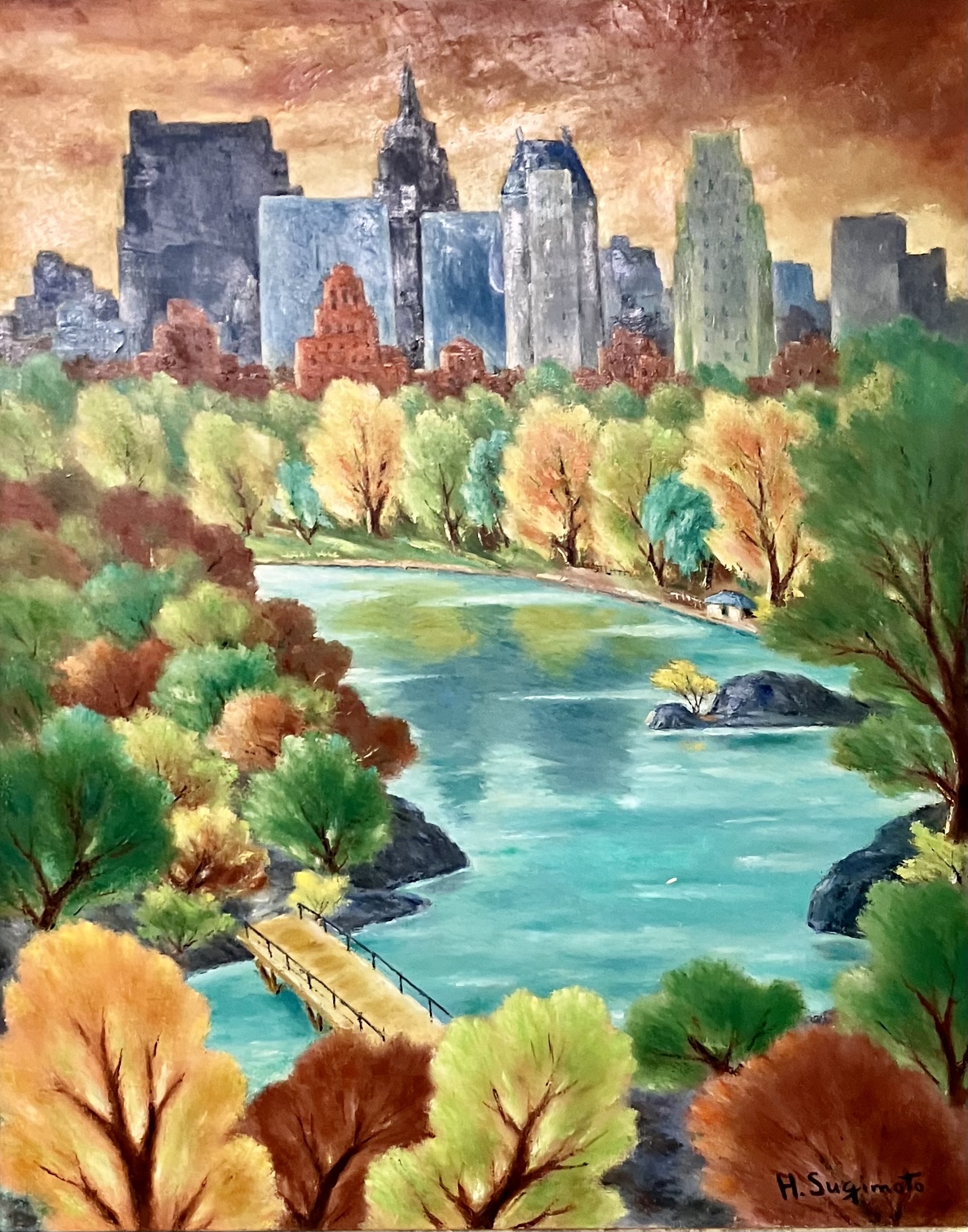
Yoshiko Uchida was among the students who were relocated from incarceration camps to the East Coast. She pursued her studies at Smith College through the wartime student relocation program and subsequently taught at a Quaker school in Philadelphia for several years prior to relocating to New York. Uchida became a prominent figure in the discourse on the internment experience, openly discussing its implications and publishing books that focused on the Japanese American experience. Uchida collaborated with Henry Sugimoto, who also relocated from the camp, and provided the artwork for New Friends for Susan, one of her children’s books about a Japanese American girl.

Student relocation did not compensate for forced removal, family separation, or the loss of homes and livelihoods. It did help bring a new generation of Japanese Americans to New York. Their presence changed the city’s institutions, artistic networks, publications, and political organizations during and after the war.

Rebuilding Community in New York

Beginning in 1943, the War Relocation Authority increasingly encouraged Japanese Americans to leave incarceration camps for approved destinations outside the West Coast exclusion zone. Leave clearance required government approval and usually an employment or educational plan. It was connected to background investigations and to the controversial loyalty questionnaire administered in the camps. Leaving camp did not restore lost property, reunite every family, or end discrimination.

New York became an important destination for people leaving the camps for school, professional work, or new employment. They encountered an established Issei community whose families, businesses, churches, and organizations had themselves been weakened by wartime detention. Rebuilding in New York therefore joined two histories: the survival of a prewar immigrant community and the arrival of Japanese Americans displaced from the West Coast.

Resettlement in New York City

In May 1944, the Church of the Brethren opened a hostel at 168 Clinton Street in Brooklyn Heights to provide temporary housing for Japanese Americans leaving incarceration camps. Although the hostel accommodated only about twenty-five people at a time, approximately 1,600 people stayed there before it closed in the spring of 1946. A larger Manhattan hostel opened at 58 East 102nd Street in October 1945. As newcomers found more permanent housing, small Japanese American communities developed around West 106th to 110th Streets, near the Japanese Methodist Church, and in Inwood, where another Japanese American church began operating.

New arrivals faced both official and private discrimination. Mayor Fiorello La Guardia publicly opposed the proposed Brooklyn hostel and declared that Japanese Americans leaving the camps were not welcome in the city. Discrimination in housing and employment persisted, even as religious organizations, private agencies, and members of New York’s established Japanese community helped newcomers find places to live, employment, and other forms of support.

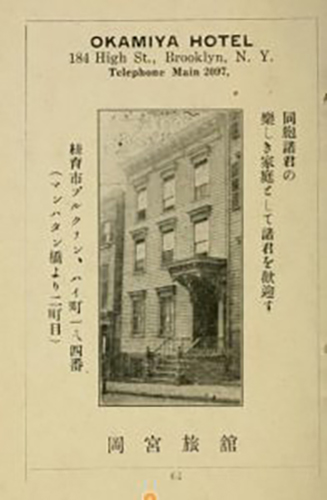
An ad for the Okimiya Hotel on High Street from the New York Japanese Address Book. Courtesy of New York Public Library

Rebuilding Community Institutions

New York’s principal Japanese community organization had roots in the Japanese Mutual Aid Society, established in 1907 by Dr. Toyohiko Takami. In 1914, Takami, Dr. Jokichi Takamine, and other leaders reorganized it as the Japanese Association of New York.

The association ceased operating during World War II after many of its leaders were detained or repatriated. Reconstituted after the war, it initially concentrated on relief for Japan. Community members collected food, clothing, and funds through organizations cooperating with Licensed Agencies for Relief in Asia.

As local needs changed, the association worked alongside the Japanese American Welfare Society (1946–1952), whose organizers included former detainees such as Rev. Alfred Akamatsu and Dr. Sabro Emy as well as Nisei leaders such as Dr. Masahiko Takami. In 1952, the two organizations merged to form the Japanese American Association of New York. The merger reflected a postwar community that included both Japanese immigrants and Japanese Americans from different regions and generations.

The Immigration and Nationality Act of 1952 removed racial barriers that had prevented Japanese immigrants from naturalizing. This change allowed eligible Issei to apply for United States citizenship, although it came after decades during which exclusion from citizenship had intensified their wartime vulnerability.

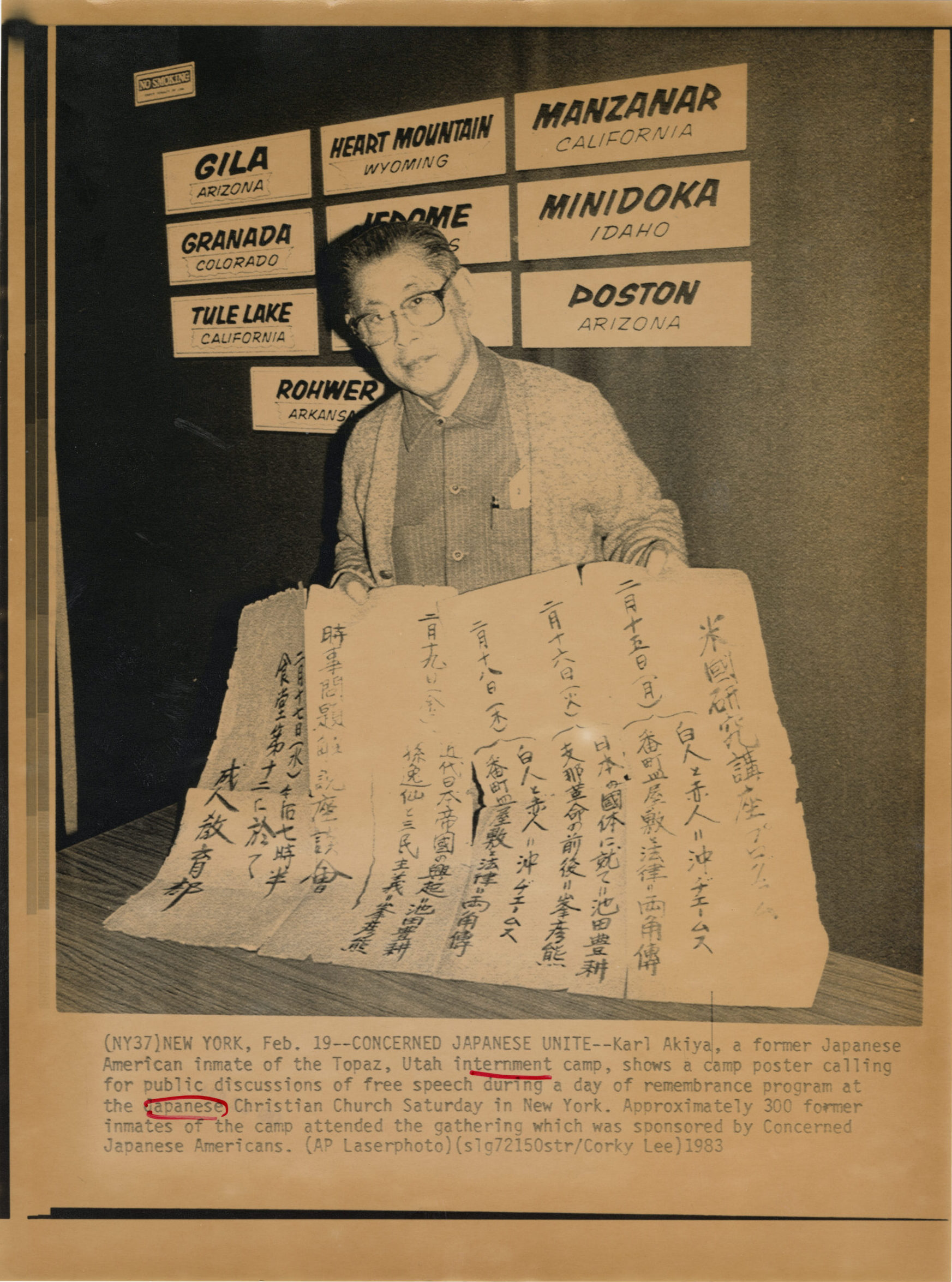
CONCERNED JAPANESE UNITE--Karl Akiya, a former Japanese American inmate of the Topaz, Utah internment camp, which was sponsored by Concerned Japanese Americans. Courtesy of Historical Society of Long Beach, Long Beach, California

Isaku Kida: Newspapers, Relief, and Community Memory

Isaku Kida (1905–1996) moved to New York in 1932. Following the attack on Pearl Harbor, he was arrested and detained at Ellis Island. He was subsequently released and worked as a Japanese-language instructor for the Office of Strategic Services.

In December 1945, Kida joined the newly established Hokubei Shimpo. Despite having no previous newspaper experience, he became chief editor in 1949 and chief executive in 1952. Through the newspaper, Kida appealed for aid to people facing severe hardship in postwar Japan. He also participated in community relief efforts. A relief-planning committee formed in September 1945 received government authorization in 1946 and formally organized as the New York Japanese American Committee for Japan Relief. The committee worked with the Licensed Agencies for Relief in Asia to send assistance to Japan.

Hokubei Shimpo also published the 1948–1949 New York Binran. The directory recorded wartime organizations, the 442nd Regimental Combat Team, community institutions, and biographies of notable Japanese New Yorkers. By documenting organizations and individuals alongside current news, the newspaper helped a dispersed and changing community preserve a record of itself.

Among the contributors to Hokubei Shimpo was Karl Ichiro Akiya, a labor and political activist who had been incarcerated at Topaz. He was released to teach Japanese at a U.S. Army language school at the University of Michigan and settled in New York in 1946. Akiya participated in the Japanese American Citizens League, the Furniture Workers Union, and the Communist Party USA. His contributions to the newspaper reflect the varied political, labor, and community networks that shaped Japanese American life in postwar New York.

Art, Testimony, and Postwar Public Life

Artists who had participated in wartime cultural and political organizations continued their work after the war. In 1948, the Whitney Museum of American Art presented a retrospective exhibition of Yasuo Kuniyoshi, the first retrospective the museum devoted to a living artist. The honor underscored a striking contradiction: Kuniyoshi was recognized as a leading figure in American art but remained legally barred from naturalization because of his Japanese birth. Although the Immigration and Nationality Act of 1952 finally removed this racial barrier, Kuniyoshi died in 1953 without becoming a United States citizen.

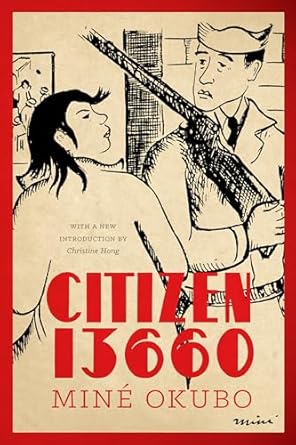
Miné Okubo (1912–2001) moved to New York after leaving Topaz to complete an illustration assignment for Fortune. She had produced thousands of drawings documenting life at Tanforan and Topaz. In 1946, she published Citizen 13660, combining concise text and drawings to describe incarceration from the perspective of a Nisei prisoner. Okubo’s work brought an individual record of confinement into postwar American public culture.

Spectators are viewing paintings and drawings of relocation center life by Miss Mine Okubo, Nisei, who resettled to new York from the Tapaz Center, at the opening of an exhibit of her work on March 6, at the American Common in New York under the auspices of the Common Council for American Unity. Courtesy of UC Berkeley, Bancroft Library
Citizen 13660 is a book about internment of Japanese Americans written by Miné Okubo. It is a an illustrated memoir by Miné that depicts the life and community within the Japanese internment camps in the United States. Originally published in 1946.

Community Legacies

The networks created through wartime displacement and migration to New York continued long after the 1940s. Kazu Iijima (1918–2007), a Nisei activist who had been incarcerated at Tanforan and Topaz, moved to New York in 1943 and became active in the Japanese American Committee for Democracy. Shizuko “Minn” Matsuda (1911–2003), a Nisei artist and activist who had moved from California to Utah before the wartime mass removal, also became involved with the organization in New York during the 1940s. Yuri Kochiyama (1921–2014), who had been incarcerated at Santa Anita and Jerome, moved to New York in early 1946 to marry William “Bill” Kochiyama, a Nisei veteran of the 442nd Regimental Combat Team who had himself been incarcerated at Topaz.

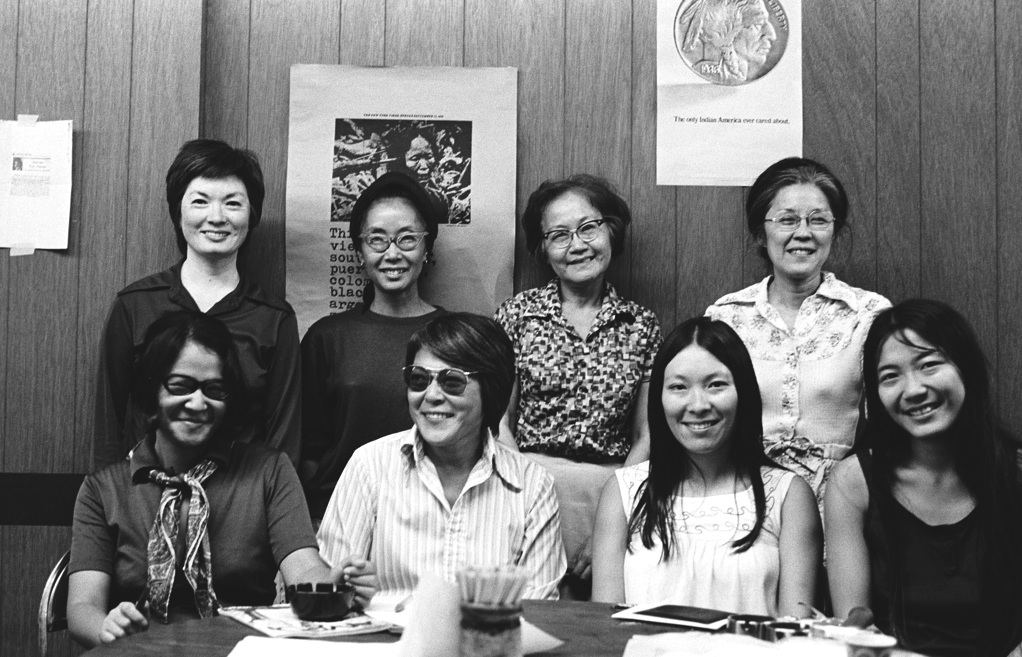
These relationships helped lay the foundation for later activism. Iijima and Matsuda founded Asian Americans for Action in New York in 1969. Yuri and Bill Kochiyama became involved in community and civil-rights causes, while Yuri emerged as a leading participant in Black liberation, political-prisoner, antiwar, and Japanese American redress movements.

Suki Terada Ports (1934– ), who grew up in wartime New York, later advocated for public education, health-care access, and people of color affected by HIV/AIDS.

Asian Americans for Action with out-of-town visitors, summer of 1973. Sitting from left: Visiting feminist from Japan, Mitzi Sawada, Amy [Tachiki] Uyematsu, Lynn [Yamashiro] Taise; standing from left: Elsie [Uyematsu] Osajima, Yuri Kochiyama, Min Matsuda, and Aiko Herzig-Yoshinaga. (Photograph by Mary Uyematsu [Kao] © 1973)
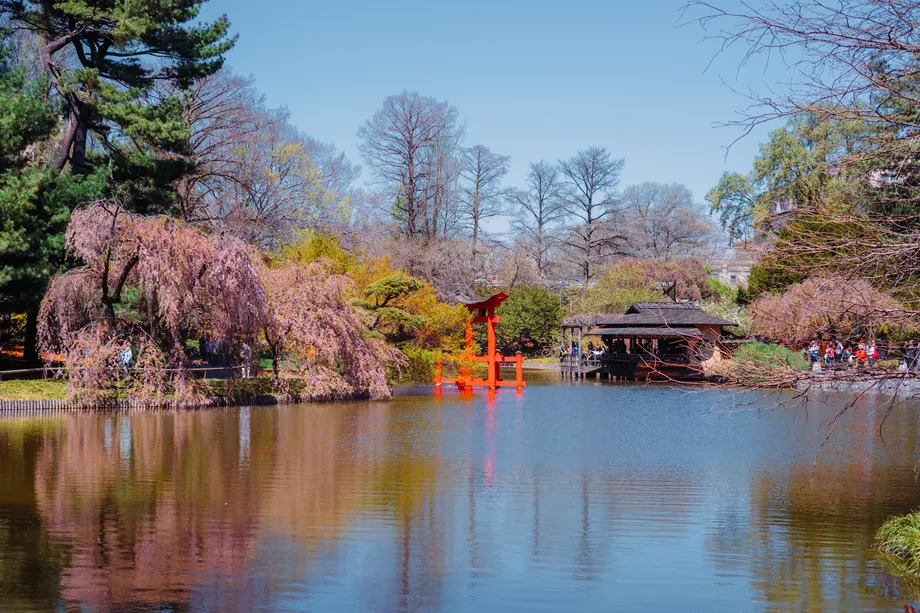
Japanese Garden at the Brooklyn Botanic Garden. © 2025 New York Department of Economic Development

The effects of wartime displacement also became visible in New York’s public spaces and community institutions. Beginning in 1947, Frank Masao Okamura (1911–2006), who had been incarcerated at Manzanar, restored and cared for the Japanese Hill-and-Pond Garden at the Brooklyn Botanic Garden, designed by Takeo Shiota and completed in 1915. George Yuzawa (1915–2011) was released from Amache in September 1943 after securing employment with a New York florist. He later joined his family’s floral business and served the Japanese American Association of New York as a vice president, board member, and committee chair.

Yuzawa also helped preserve and restore the Japanese burial ground at Mount Olivet Cemetery in Queens. The burial ground had been purchased in 1912 by the Japanese Mutual Aid Society, founded by Dr. Toyohiko Takami, to provide a resting place for Japanese immigrants who died in New York without family members able to arrange their burial. The federal government seized and auctioned the cemetery’s Japanese plots in 1943. Yuzawa’s preservation work and support for memorial observances connected the postwar Nisei community with the Issei generation that had established Japanese community institutions before the war. In 1982, Yuzawa and the association also helped establish the Sakura Matsuri Cherry Blossom Festival at the Brooklyn Botanic Garden.

Postwar Japanese New York was not simply a restoration of the community that had existed before Pearl Harbor. It was a community remade by detention, forced removal, military service, migration, and resettlement. The losses caused by war could not be undone. Yet through the institutions they rebuilt, the records they preserved, the gardens and burial grounds they cared for, and the movements for social justice they helped shape, Japanese and Japanese American New Yorkers created an enduring community and carried the memory of earlier generations forward.

Azuma, Eiichiro. “Issei in New York, 1876–1941.” Discover Nikkei: Japanese American National Museum Magazine, July 7, 2014. https://discovernikkei.org/en/journal/2014/7/7/issei-in-new-york/.

David Zwirner. “Leo Amino: The Visible and the Invisible.” Exhibition, July 6–31, 2020. https://www.davidzwirner.com/exhibitions/2020/leo-amino-the-visible-and-the-invisible.

Densho Encyclopedia. “Japanese American Committee for Democracy.” Last modified June 13, 2024. https://encyclopedia.densho.org/Japanese_American_Committee_for_Democracy/.

Handel-Bajema, Ramona. Art across Borders: Japanese Artists in the United States before World War II. Honolulu: University of Hawai‘i Press, 2022. https://uhpress.hawaii.edu/title/art-across-borders-japanese-artists-in-the-united-states-before-world-war-ii/.

Hokubei Shimpo, ed. Nyuyoku Binran, 1948–1949. New York: Hokubei Shimpo, 1948.

Matsumoto, Toru, and Marion Olive Lerrigo. A Brother Is a Stranger. New York: John Day Company, 1946.

Mizutani, Shiozo. Nyuyoku Nihonjin Hattenshi [A History of Japanese People in New York]. New York: Nyuyoku Nihonjinkai, 1921.

O’Brien, Robert W. The College Nisei. Palo Alto, CA: Pacific Books, 1949. https://catalog.hathitrust.org/Record/005907332.

Pegler-Gordon, Anna. “‘New York Has a Concentration Camp of Its Own’: Japanese Confinement on Ellis Island during World War II.” Journal of Asian American Studies 20, no. 3 (October 2017): 373–404. https://doi.org/10.1353/jaas.2017.0033.

Robinson, Greg. After Camp: Portraits in Midcentury Japanese American Life and Politics. Berkeley: University of California Press, 2012. https://www.ucpress.edu/book/9780520271593/after-camp.

———. “Leo Amino: Building a Brighter Art through Plastics, Part 1.” Discover Nikkei, March 24, 2022. https://discovernikkei.org/en/journal/2022/3/24/leo-amino-1/.

———. “Nisei in Gotham: The JACD and Japanese Americans in 1940s New York.” Prospects: An Annual of American Cultural Studies 30 (2005): 581–95. https://doi.org/10.1017/S0361233300002143.

———. The Unsung Great: Stories of Extraordinary Japanese Americans. Seattle: University of Washington Press, 2020. https://uwapress.uw.edu/book/9780295747965/the-unsung-great/.

United States Holocaust Memorial Museum. “Arthur Jacobs Photograph Collection.” Accession no. 2017.636.1. Gift of Arthur Jacobs. Accessed August 15, 2026. https://collections.ushmm.org/search/catalog/irn562944.

Urban, Andrew, supervising professor. Invisible Restraints: Life and Labor at Seabrook Farms. Online exhibition created by undergraduate and graduate students at Rutgers University, 2015–16. https://exhibits.libraries.rutgers.edu/seabrook_farms/.

Wang, ShiPu, ed. Pictures of Belonging: Miki Hayakawa, Hisako Hibi, and Miné Okubo. Berkeley: University of California Press, 2023. Exhibition catalog. https://www.janm.org/exhibits/pictures-of-belonging/resources.

War Relocation Authority. “Students at the New Jersey College for Women, New Brunswick, New Jersey, View an Exhibit of Paintings and Sculptures by Issei and Nisei Artists.” Photograph, 1945. War Relocation Authority Photographs of Japanese-American Evacuation and Resettlement, BANC MSS 67/14 c, The Bancroft Library, University of California, Berkeley. https://calisphere.org/item/ark:/13030/ft6j49p000/.

Wolf, Tom. “The Tip of the Iceberg: Early Asian American Artists in New York.” Yun Gee. Accessed August 15, 2026. https://yungee.com/the-tip-of-the-iceberg-early-asian-american-artists-in-new-york-by-tom-wolf.

———. The Artistic Journey of Yasuo Kuniyoshi. Washington, DC: Smithsonian American Art Museum; London: D Giles, 2015. Exhibition catalog. https://americanart.si.edu/books/kuniyoshi.
This exhibition was organized by the Digital Museum of the History of Japanese in New York.

This exhibition was made possible with support from:

The J.C.C. Fund
The Consulate General of Japan in New York
The SMBC Global Foundation
The UCLA Asian American Studies Center and the Aratani C.A.R.E. Award

Project Manager: Mac Gill

Curator: Yuka Yokoyama

Exhibition Advisors

Greg Robinson, Professor of History, Université du Québec à Montréal
Genji Amino, Director, Leo Amino Estate
Shun Ito, Assistant Professor, Graduate School of Education, Okayama University

Special Thanks

Michiyo Noda, Japanese American Association of New York
Eiko Aono and Akemi Takeda, JAA Archive Volunteers
Jamie Henricks, Archivist, Japanese American National Museum
Hoshina Seki, New York Buddhist Church
Kathryn Bannai, Board Member, Japanese American National Museum
Lance B. Stuart, Donor of the Jiro Kozai Family Collection

Materials appearing in this exhibition are provided by:

Japanese American Association of New York
Lutnick Library, Haverford College
Seabrook Educational and Cultural Center
Rutgers University Libraries
U.S. National Archives and Records Administration
Discover Nikkei
Densho
Japanese American National Museum
New York Public Library
The Bancroft Library, University of California, Berkeley
Leo Amino Estate
American Friends Service Committee

Additional credits appear in the individual image captions.