
Exhibit Resources Exhibit Resources 展示に関する資料 Themes テーマ Media Types 資料の種類 Exhibit Resources 展示に関する資料 Alphabetical Order アルファベット順 Chronological Order 年代順 Recently Added 最近追加された記事 Alphabetical Order Chronological Order Recently Added
Volunteer Content Entry
Volunteer Content Management Add New Artifact Test Artifact Half Century of Japanese Artists in New York at Azuma Gallery: Planning Document and Exhibition Booklet Norio Araki Japanese Businessmen Arrive on the Oceanic Morimura Brothers Store on Broadway, 1893 The oldest article believed to be written by Asahi Shimbun’s New York correspondent The Japanese Ambassadors A Mainichi Newspaper Correspondent Returns to the United States after WWII Nippon TV broadcasts live via satellite from its New York studio to Tokyo
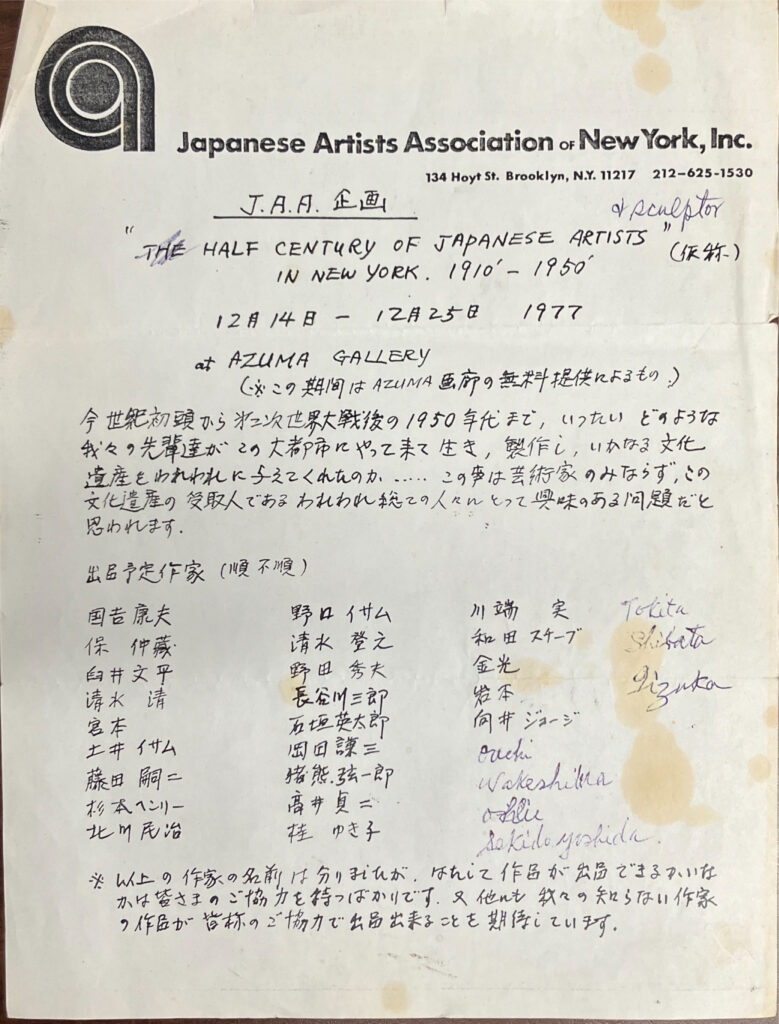
Half Century of Japanese Artists in New York 1910-1950 exhibition at Azuma Gallery (1977)
デジタル展示
EXHIBITS
Support
OUR SUPPORTERS Your generous support ensures that future generations will have access to these histories, exhibits, and cultural resources. We gratefully recognize our supporters through the following tiers of acknowledgment. 2026 CORPORATE SPONSORS Meiji Mitsubishi Corporation (Americas) Mitsui & Co. (USA), Inc. Mizuho Americas Taisho Daiwa Capital Market Ito En (North America) Inc. Tokio Marine Management Sumitomo Corp. of America ORIX Corp Deloitte MUFG UNION BANK Showa KPMG Suntory America Heisei DNP America LLC KDDI AMERICA INC. NYK Group America Kawasaki Heavy Industries (USA) Nippon Life Americas COMMUNITY SUPPORTERS The Nippon Club & J.C.C. Fund The Japanese American Association of New York INDIVIDUAL SUPPORTERS GRANT SUPPORTERS The Japan Foundation, […]
寄付
MAKE A GIFT Support the Digital MuseumSince its launch in 2021, the Digital Museum has shared underrepresented stories of Japanese and Japanese Americans who have contributed to New York’s rich history and culture. Your support helps us preserve these histories, expand access to our digital exhibits and archives, and pass these stories on to future generations. If you would like to donate by check, please make a check payable to: THE DIGITAL MUSEUM OF THE HISTORY OF JAPANESE Mail your check to: c/o The Japanese American Association of New York, Inc. 49 West 45th Street, 5th FloorNew York, New York 10036 THANK YOU.
Board Members
Board Members Lorem ipsum dolor sit amet, consectetur adipiscing elit. Ut elit tellus, luctus nec ullamcorper mattis, pulvinar dapibus leo. Lorem ipsum dolor sit amet, consectetur adipiscing elit, sed do eiusmod tempor incididunt ut labore et dolore magna aliqua. Ut enim ad minim veniam, quis nostrud exercitation ullamco laboris nisi ut aliquip ex ea commodo consequat. Duis aute irure dolor in reprehenderit in voluptate velit esse cillum dolore eu fugiat nulla pariatur. Excepteur sint occaecat cupidatat non proident, sunt in culpa qui officia deserunt mollit anim id est laborum.
コレクション
COLLECTIONS
Artworks in Gacho-kai Exhibition
1921 Gacho-kai Exhibition Fig. 7. T.K. Gado, FamilyFig. 8. T.K. Gado, Rush Hour in SubwayFig. 9. T.K. Gado, Rush Hour in SubwayFig. 10. Masaji Hiramoto Previous slide Next slide The Gacho-Kai exhibition featured Western paintings influenced by realistic techniques and modernism, as opposed to the works that pandered to Oriental tastes for commercial purposes that were criticized during the Japan Art Association’s exhibitions in the 1910s. As such, the exhibition was intended to showcase the work of Japanese who had studied art in the region and to introduce both the Japanese community and the American community in New York City to the ways in which they had mastered the techniques […]
April 1940 American Artists’ Congress 4th Annual Exhibition
April 1940 American Artists’ Congress 4th Annual Exhibition Fig. 122. Sakari Suzuki, “Landscape”Fig. 123. Chuzo Tamotzu, “Problem” The fourth annual American Artists’ Congress exhibition was held in April 1940 and included works by Yasuo Kuniyoshi, Eitaro Ishigaki, Chuzo Tamotzu, Sakari Suzuki, and Thomas Nagai. Two of these works, Suzuki Sakari “Landscape” (Fig. 122) and Chuzo Tamotzu “Problem” (Fig. 123), are the only identifiable works from the exhibition. The Fourth Annual Exhibition in 1940 is considered the last annual exhibition of the Congress of American Artists. Following the Soviet invasion of Finland in the year prior to the exhibition, disagreements deepened within the organization between communists and liberals. In April 1940, […]