
The Japan Pavilions at the New York World's Fairs
in 1939-1940 and 1964-1965
in 1939-1940 and 1964-1965
The Japan Pavilions at the New York World's Fairs
in 1939-1940 and 1964-1965

Viewed together, Japan’s participation in the New York World’s Fairs of 1939–40 and 1964–65 traces a broader historical shift. In 1939, architecture served as an explicit vehicle for national symbolism. Historic forms framed a carefully managed message, and the architect’s role was largely instrumental, aligned with state priorities at a moment of growing geopolitical strain.

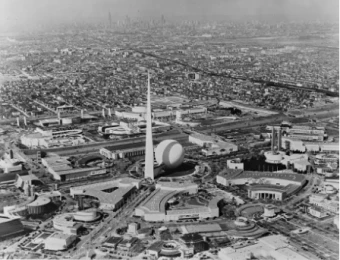
Manuscripts and Archives Division, The New York Public Library.
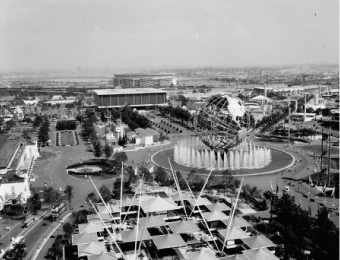
Manuscripts and Archives Division, The New York Public Library.
By 1964, that clarity had given way to a more ambiguous situation. Japan returned to New York as a postwar nation marked by economic recovery and growing international visibility, but also by competing expectations about what that recovery should signify. The official pavilion designed by Mayekawa Kunio reflected these tensions. Its restrained modernism and its relationship to Nagare Masayuki’s stone wall sat uneasily within a fair driven by spectacle, commercial competition, and the demands of an automobile-centered site, registering less as a declaration than as a negotiated presence.
The fate of these structures underscores that tension. The disappearance of the Japanese pavilion from Flushing Meadows reflects not only the end of the fair, but also the misalignment between architectural intent and the frameworks meant to sustain it. That Nagare’s work was deemed “too unwieldy” to reinstall speaks as much to the limits of local expertise and institutional commitment as to the architecture itself.
Ultimately, the contrast between 1939 and 1964 marks a shift from overt national representation to negotiated modernism, and from architecture as an instrument of state messaging to architecture as a site shaped by professional agency and historical contingency. In this sense, the New York World’s Fairs offer insight not only into changing images of Japan, but into the evolving role of architecture in the twentieth century.
Caro, Robert, The Power Broker: Robert Moses and the Fall of New York (Vintage Books, 1975)
Holt, Elizabeth, The Art of All Nations, 1850-73: The Emerging Role of Exhibitions and Critics (Princeton University Press, 1982)
Inouye, Daniel, Distant islands: the Japanese American community in New York City, 1876-1930s (University Press of Colorado, 2018)
Lockyer, Angus, Exhibitionist Japan: The Spectacle of Modern Development (Cambridge University Press, 2025)
New York Nichibei
New York Times
New York World’s Fair 1939 and 1940 Incorporated Records, 1935- 1945, Manuscripts and Archives Division, New York Public Library
New York World’s Fair 1964-1965 Corporation Records, 1959-1971, Manuscripts and Archives Division, New York Public Library
Nichibei Jihō
Official Guide Book of the New York World’s Fair, 1939 (New York: Exposition Publications, 1939)
Official guide, New York World’s Fair 1964/1965 (New York: Time Incorporated, 1964)
Rydell, Robert W., World of Fairs: The Century-of-Progress Expositions (University of Chicago Press, 1993)
The Japanese Pavilion, New York World’s Fair, 1939 (Japanese Commission to the New York World’s Fair, 1939)
Yoshida Mitsukuni, Bankoku Hakurankai: Gijutsu Bunmeishi-teki ni (NHK Books, 1985)
Yoshimi Shun’ya, Hakurankai No Seijigaku: Manazashi No Kindai (Chūō kōronsha, 1992)
Young, Bill, nywf64.com: The website of the 1964/1965 New York World’s Fair (2022), http://www.nywf64.com/index.html