
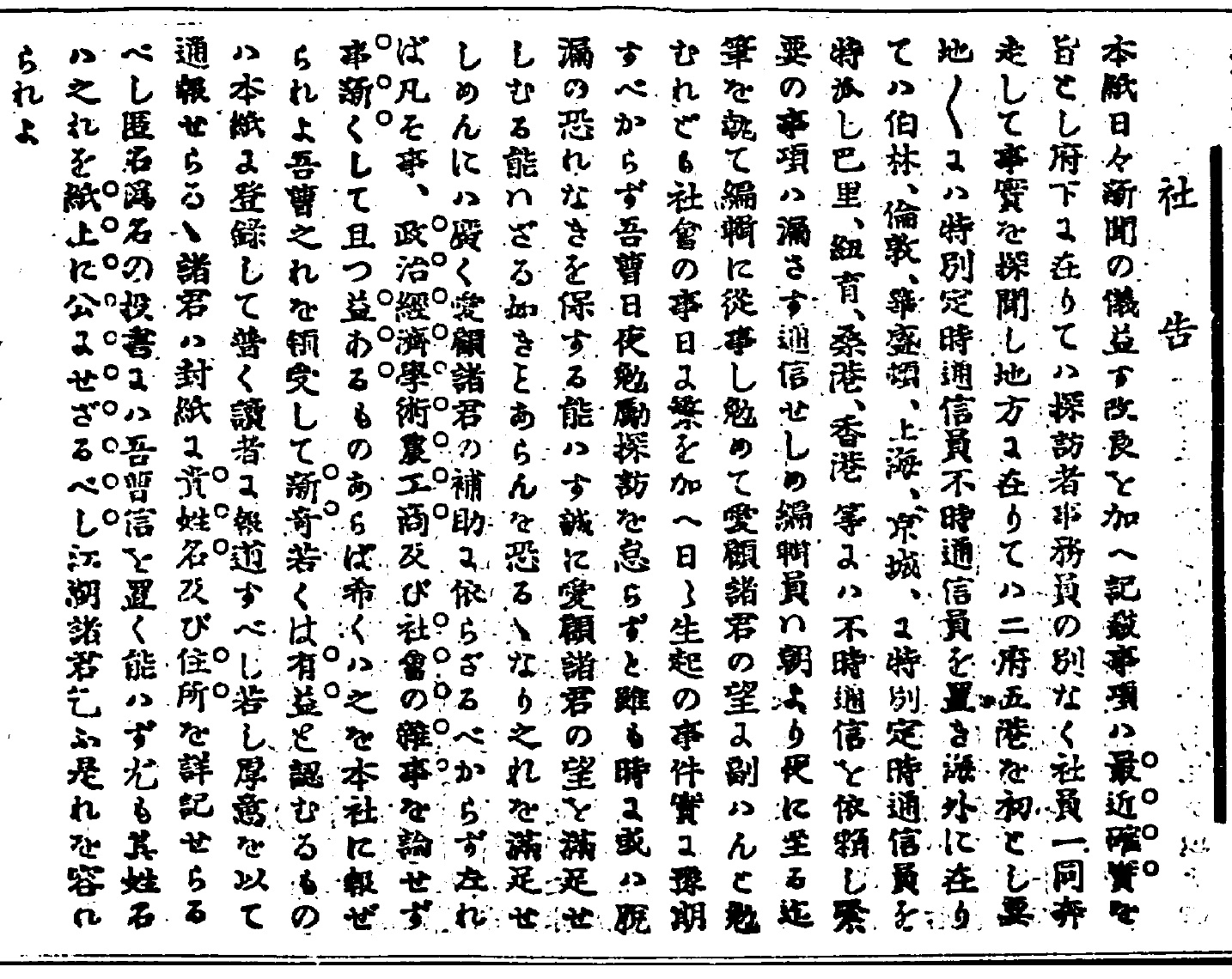

These materials document the development, interruption, and postwar restoration of the overseas reporting network of the newspaper company that later became the Mainichi Shimbun, with particular attention to its activities in New York.
The Tokyo Nichi Nichi Shimbun, founded in 1872, and the Osaka Mainichi Shimbun became part of the same newspaper organization through a corporate merger in 1911. Although the two papers continued to be published under their regional titles for several decades, both adopted the name Mainichi Shimbun in 1943. Their expanding network of foreign correspondents reflected the newspaper company’s effort to establish itself as a major national and international news organization.
New York occupied an important place in this network. As a center of finance, commerce, immigration, communications, and international affairs, the city offered Japanese newspapers access not only to American news but also to developments affecting the wider world.
In July 1919, the Osaka Mainichi Shimbun dispatched journalist Motosaburo Takata to New York as its first permanent correspondent in the United States. Takata had joined the newspaper’s foreign news division after graduating from Tokyo Imperial University. His appointment came at a time when Japanese newspapers were placing greater importance on direct overseas reporting following World War I.
Although based in New York, Takata traveled to Washington and other cities to report on major political, diplomatic, and economic events. He covered the first International Labour Conference in Washington in 1919 and later reported on the Washington Naval Conference of 1921–22. His work connected readers in Japan with developments in American politics and international diplomacy at a time when relations between Japan and the United States were becoming increasingly consequential.
Takata returned to New York for a second assignment in 1926. His repeated posting suggests that New York had developed from a location used for occasional reporting into an established base within the company’s international news-gathering system. He later served in London and reported from Europe before returning to Japan, where he held senior editorial and executive positions. The international experience he gained in New York, Washington, and Europe helped shape his later leadership in Japanese journalism.
One document in this collection is a company announcement describing the newspaper’s domestic and international communications network. It identifies regular special correspondents in Berlin, London, Washington, Shanghai, and Seoul, as well as emergency correspondents who could be dispatched to Paris, New York, San Francisco, and Hong Kong when major events required direct coverage. The announcement illustrates how the company sought to link its newsrooms in Japan with important political, commercial, and communications centers around the world.
A related article records the dispatch of the newspaper’s first correspondent to the United States after the Pacific War. During the war, overseas correspondents had been required to return to Japan, interrupting the company’s direct reporting from the United States. The postwar appointment therefore marked an important step in rebuilding its international operations and restoring journalistic connections between Japan and New York.
Together, these materials trace New York’s changing role in the history of the Tokyo Nichi Nichi Shimbun and the Mainichi Shimbun. Before the war, the city served as a base for reporting on American society, international diplomacy, and world affairs. After the wartime interruption, the return of a correspondent to the United States symbolized the restoration of direct communication and the reconstruction of the newspaper’s global reporting network.
No results found.
No results found.